
Understanding what the data shows—and what it doesn’t.
Welcome back to Data Detective, where we walk step by step through public data to uncover what’s really happening in Illinois’ economic and demographic landscape.
In recognition of National Arab American Heritage Month (NAAHM), this edition focuses on a question that may seem simple but is rather quite layered:
How many Arab Americans live in Illinois?
As we’ll see, the answer depends on where you look (and how the data is defined).
What Defines an Arab American?
In most public datasets, the answer comes down to ancestry, including individuals who trace their heritage to Arabic-speaking countries such as Lebanon, Egypt, Syria, and others.
But this is where things become more complex. Arab identity is tied to cultural and linguistic factors, and it is currently not recognized as a distinct racial category in most federal data systems. Instead, Arab Americans are generally classified as “White” in Census data.
This means that identifying Arab American populations requires a more detailed approach, relying on ancestry rather than race. And while broader regional categories like Middle Eastern and North African (MENA) are sometimes used, they include both Arab and non-Arab populations, making them an imperfect substitute.
Step 1: Navigating Census Data
To explore this population using federal data, head to data.census.gov, the U.S. Census Bureau’s primary data platform.
In the search bar, enter:
“B04006 Illinois”
The People Reporting Ancestry table the most common approach in estimate Arab American populations.
Step 2: Filter the Parameters
In the Geographies tab, you can also drill down further into counties, metro areas, or cities if you want to explore where Arab American populations are concentrated within the state.
Under Time, select the most recent available dataset. In this instance, we’ll be using 2024 ACS 5-Year Estimates.
Note: 5-year estimates are generally preferred for smaller populations, as they provide more stable data.
Step 3: Identifying Arab Ancestry Groups
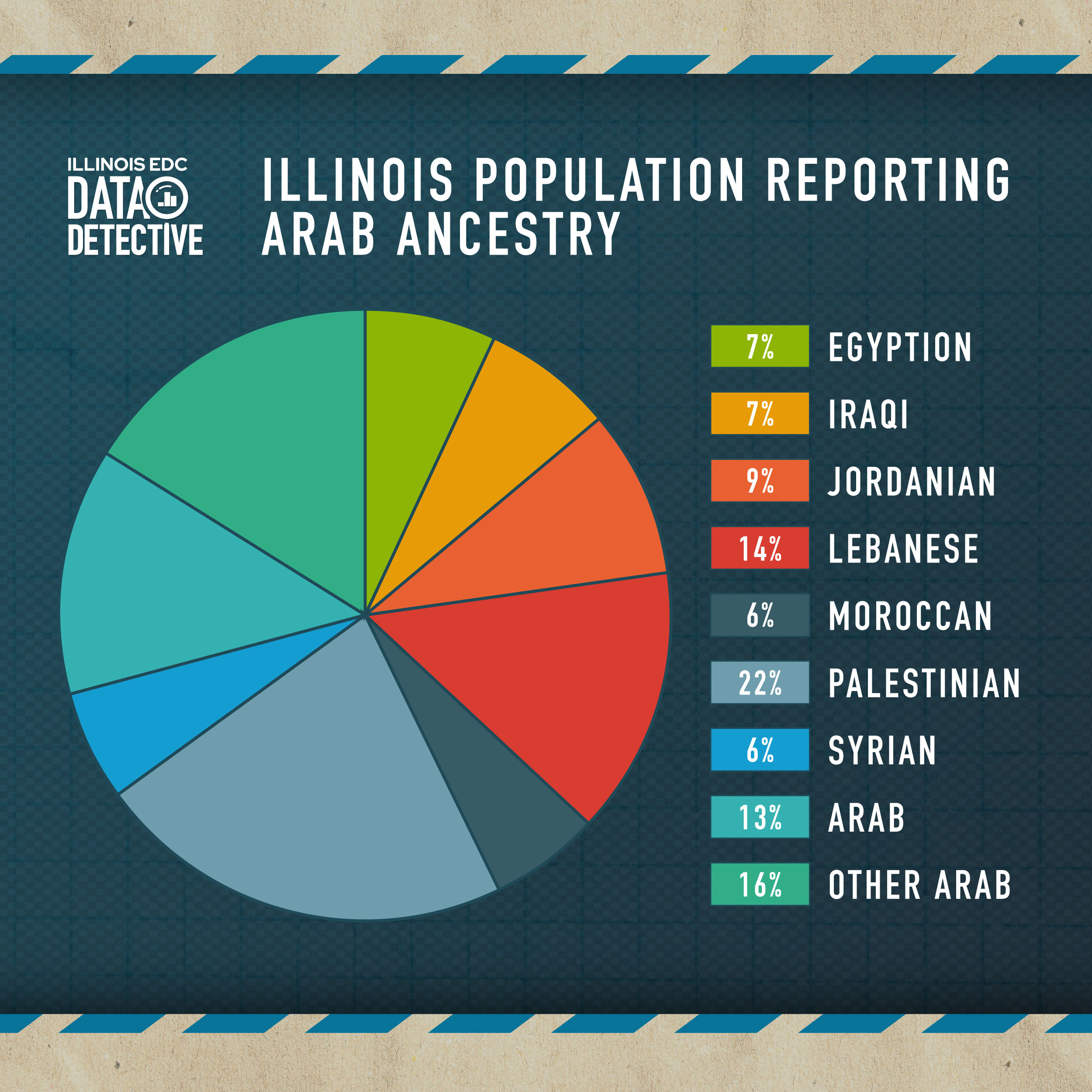
Using ancestry-based estimates from the American Community Survey, Illinois is home to a substantial Arab American population of an estimated 99,348 Arab Americans, with major concentrations in the Chicago metropolitan area. Upon clicking on the “Arab” dropdown in Table B04006, you will find the following subgroup breakdown:
Step 4: Identify Limitations
While Census data is a valuable starting point, it has important limitations:
- No MENA Category (Yet)
- Arab Americans are still classified as White in federal race categories. This means:
- They are not easily identifiable in standard race tables.
- Their population may be undercounted or obscure.
- Ancestry Is Self-Reported
- Not everyone reports ancestry the same way:
- Some individuals may list “American” or a broader identity.
- Others may report multiple ancestries.
- Second- or third-generation individuals may not report specific origins.
- Not everyone reports ancestry the same way:
- Fragmentation Across Categories
- Because Arab Americans are spread across multiple country-of-origin categories, it requires manual aggregation, which can introduce inconsistencies.
- Arab Americans are still classified as White in federal race categories. This means:
Step 5: Look Across Other Sources
To address these gaps, organizations like the Arab American Institute produce their own estimates using a combination of Census data and modeling techniques.
Their estimate places Illinois’ Arab American population at approximately 181,139 residents. This is over 80% higher than the Census-based figure.
Step 6: Future Considerations
Recognizing these limitations, Illinois has taken steps to improve data collection.
In 2023, Illinois Governor JB Pritzker signed House Bill 3768 into law, making Illinois the first state to formally recognize Middle Eastern and North African (MENA) as a distinct demographic category in state data collection across agencies.
It’s important to note that MENA is a broader regional classification and does not exclusively represent Arab populations. However, the addition of a MENA category is still a significant step forward, as it allows populations that have historically been categorized as “White” in federal data to be more accurately identified in state-level data collection.
As of July 1, 2025, this designation:
- Allows for more accurate representation in state-level data
- Improves visibility for Arab American communities
- Supports more targeted policymaking and resource allocation
At the federal level, the U.S. Census Bureau is also expected to include a MENA category in the 2030 Census, marking a significant shift in how these populations are counted nationwide.
Key Takeaway
Counting Arab Americans in Illinois isn’t as simple as pulling a single number.
Instead, it requires:
- Understanding how identity is defined
- Navigating multiple data sources
- Recognizing the limitations of existing datasets
As new policies like Illinois’ MENA classification take effect, future data will offer a clearer and more complete picture of this community.
In the meanwhile, being a good data detective means knowing not just what the data says, but what it leaves out as well.
Get Curious
What data would you like our Research Team to tackle next? Let us know, and we’ll dive in.
Until next time!
RELATED POSTS