Illinois EDC’s Christy George and IQMP’s Harley Johnson were featured on Chicago Newsroom 2.0, highlighting how IBM’s FutureNow Chicago Delivery Center will be a catalyst for innovation and economic opportunity
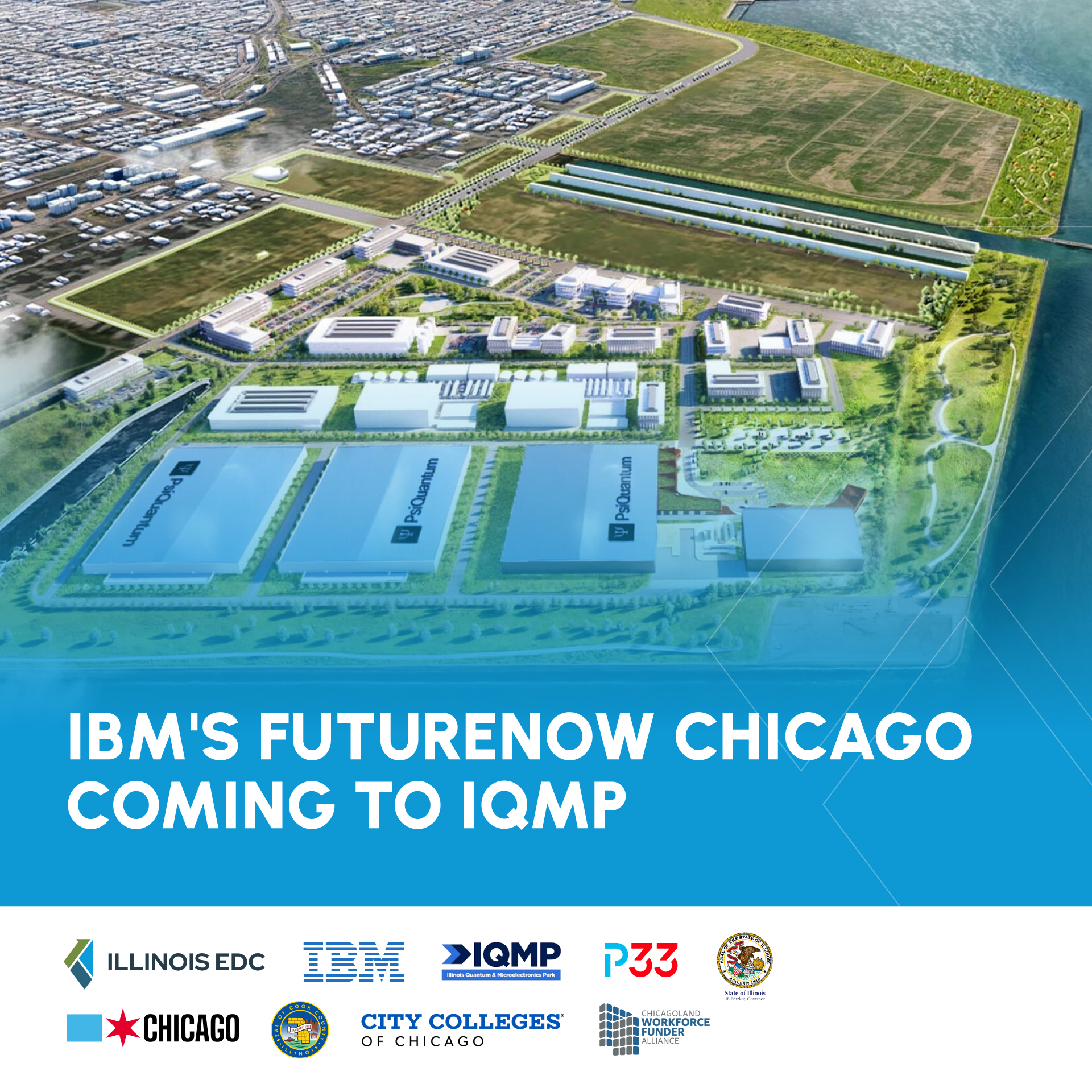
IBM is doubling down on Illinois in a big way, announcing that it will establish the FutureNow Chicago Delivery Center at the Illinois Quantum and Microelectronics Park (IQMP). The center will create 750 new jobs and train City Colleges of Chicago apprentices across in-demand fields such as artificial intelligence, quantum computing, cybersecurity and data science.
Illinois EDC President and CEO Christy George sat down with Chicago Access Network Television (CAN TV) co-host Glenn Eden and IQMP CEO Harley Johnson about IBM’s historic investment.
Watch their full conversation on YouTube (~47:00) or read the transcript below.

FULL TRANSCRIPT
This auto-generated transcript has been edited slightly for grammar and clarity.
Glenn Eden: Chicago is positioning itself at the forefront of one of the fastest growing sectors in the global economy: quantum computing, artificial intelligence, cybersecurity, and advanced microelectronics. A major part of that vision is now taking shape on the city’s South Side through the Illinois Quantum and Microelectronics Park, or IQMP, where IBM is launching its new FutureNow Chicago Delivery Center. The initiative is expected to create 750 new jobs in high-growth technology fields while also building a new pathway for Illinois residents to access careers in the innovation economy. But beyond the headlines and billion-dollar projections, leaders say this effort is about something even bigger: creating equitable access to opportunity, investing in workforce development, and ensuring that local communities are a part of the future being built right here in Chicago. Joining us now to talk about the vision, the partnerships, and what this could mean for the future of Illinois’s economy are Christy George, President and CEO of the Illinois Economic Development Corporation, and Dr. Harley Johnson, CEO of the Illinois Quantum and Microelectronics Park. Christy, Dr. Johnson, thank you for joining the Chicago Newsroom 2.0. Happy to have you here with us.
Christy George and Harley Johnson: Thank you for having us.
Glenn Eden: We’re going to get straight into it. Christy, IBM’s FutureNow Chicago initiative is expected to create 750 jobs in fields like AI, cybersecurity, data science, and quantum technology. What does it say about Illinois and Chicago specifically that IBM chose the IQMP as the home for this investment?
Christy George: Thank you for the question. It means a lot. To put it simply, IBM is a legacy company in Illinois. They have a significant footprint in the state, both in Chicago and in Springfield and other parts of the state. But what it truly means is that they are doubling down on Chicago. They believe in our workforce, they believe in our abilities, and they believe in a true partnership with Illinois and with Chicago. What we saw here is that IBM thought through the variety of different partnerships they have and all of the assets and strengths available to them. They have a very strong partnership with the University of Illinois, and they also have a very strong partnership with the University of Chicago. And certainly, they had already made an investment in partnership with the Illinois Quantum and Microelectronics Park to develop the National Quantum Algorithm Center and to locate their Quantum System Two here in Chicago in partnership with IQMP. Beyond that, they have such core strengths, and we have such key assets here. We have not only our universities, but also an incredible community college system—the third largest in the nation. In particular, City Colleges of Chicago has so many programs, with incredible assets and incredible teachers and partnerships, and they truly work within communities to build the workforce of the future. So, what they did here is enter into this partnership to really take on and think through how we can challenge the corporate community to address workforce development in a different way. This is a different type of model—they entered into this partnership with City Colleges of Chicago to develop the FutureNow Center at the IQMP. The goal of that FutureNow Center is really twofold. The first part is creating a center that allows them to partner with industry to address real-world challenges and develop real-world solutions. The second facet is workforce development—building a talent engine within the IQMP focused on cyber, AI, risk mitigation, data science, and all of these different facets. They’re doing that in partnership with the City of Chicago and City Colleges of Chicago, and it’s such a fantastic partnership—we’re so proud of it. They’ve already started hiring folks, so it’s really incredible. It’s a true testament to what’s possible when government comes together with industry, supported by higher education, our community college system, and even further, philanthropy. It’s a truly incredible partnership.
Glenn Eden: Yeah, absolutely. Dr. Johnson, the IQMP has been described as a first-of-its-kind campus for quantum technology and microelectronics innovation. For viewers hearing about quantum computing for the first time—who aren’t rocket scientists—can you help us understand why this industry matters and why there’s such urgency around building this ecosystem now? It is very comprehensive, as Christy just discussed.
Harley Johnson: IQMP is a campus designed to promote the scale-up of quantum technologies. There are different kinds of quantum technologies, but we’re focused primarily on quantum computing. Quantum computing is a form of computing that we think will transform the way we use computers to solve big problems—the kinds of problems that companies, small businesses, and individuals across the city, the region, and the country needs that can be addressed by computers. We’re talking about problems currently out of range for existing computers: drug discovery, other healthcare challenges, and problems related to environmental sustainability—the kinds of things that impact everyday people, but that our existing computers aren’t equipped to handle. So, there’s urgency because of the nature of the problems we want to solve, but there’s also urgency because of the opportunity. This is an opportunity that’s unique to Chicago because of the nature of the workforce here and the training programs that Christy mentioned. I think we have an opportunity to seize that and ensure that the citizens of Chicago and the region are first to the party and can access those kinds of jobs and careers as soon as possible.
Glenn Eden: Wow, yeah, absolutely. So, to dovetail off of that—one of the most striking aspects of the project is the focus on workforce development and apprenticeships. How intentional was the decision to ensure that these opportunities are accessible not only to traditional four-year degree holders and engineers, but also to community college students and local residents at large?
Harley Johnson: Very intentional. This has been part of the strategy and the plan all along. Studies show that over the next 10, 20, 30 years, this industry will create tens of thousands of jobs. Not all of them will be at IQMP—many will be spread across companies that use these kinds of computing technologies. The studies also show that these jobs won’t all be set aside for people with advanced degrees. Most of the jobs, in fact, will be for bachelor’s degree or associate’s degree holders. So, the thinking has always been very intentional about putting those programs in place, because right now we don’t have the workforce trained in those areas. And a lot of the people who will hold those jobs in 10 or 20 years are in middle school right now, so we’re thinking about K-through-12 education as well as associate’s degree holders. Certainly, the IBM FutureNow program is focusing primarily on apprenticeship-level jobs and associate’s degree holders, but it really spans the whole spectrum. That’s been very intentional in making these jobs accessible.
Glenn Eden: Yeah, absolutely.
Christy George: And if I can just add to that—specifically, of the 750 jobs, 180 of them will come out of this apprenticeship program. So as Dr. Johnson was sharing, it’s very intentional, and it’s built into the hiring model for the FutureNow Center, which is incredible.
Glenn Eden: So, as our final question—looking ahead five to ten years, what do you hope people will say about the impact the Illinois Quantum and Microelectronics Park and the FutureNow Chicago initiative had on Chicago’s economy, workforce, and national reputation as a technology hub, particularly an advanced technology hub?
Harley Johnson: I’m so excited about what the next five to ten years hold. Think about all the other great things happening on the South Side right now—we hope IQMP can play a role in attracting attention, prosperity, and opportunity to that part of our community. This can be a place that’s internationally recognized as a center of the high-tech world, and it can also be an example of how we spread opportunity to the rest of the community.
Christy George: What I’d like to see is even more FutureNow delivery centers throughout the state and throughout the nation. One of the key differences here is that this is a first-of-its-kind model in developing this kind of partnership—and the true node of success isn’t just the jobs being hired or the investment being made, but whether this model gets replicated elsewhere. Is this a new model of economic development that can scale in different parts of the country? That’s what we want to see.
Glenn Eden: Well, it’s great to have Chicago and Illinois be the North Star on this path forward for advanced technology. Thank you all for being here—we’ll have to have you back soon.
RELATED POSTS