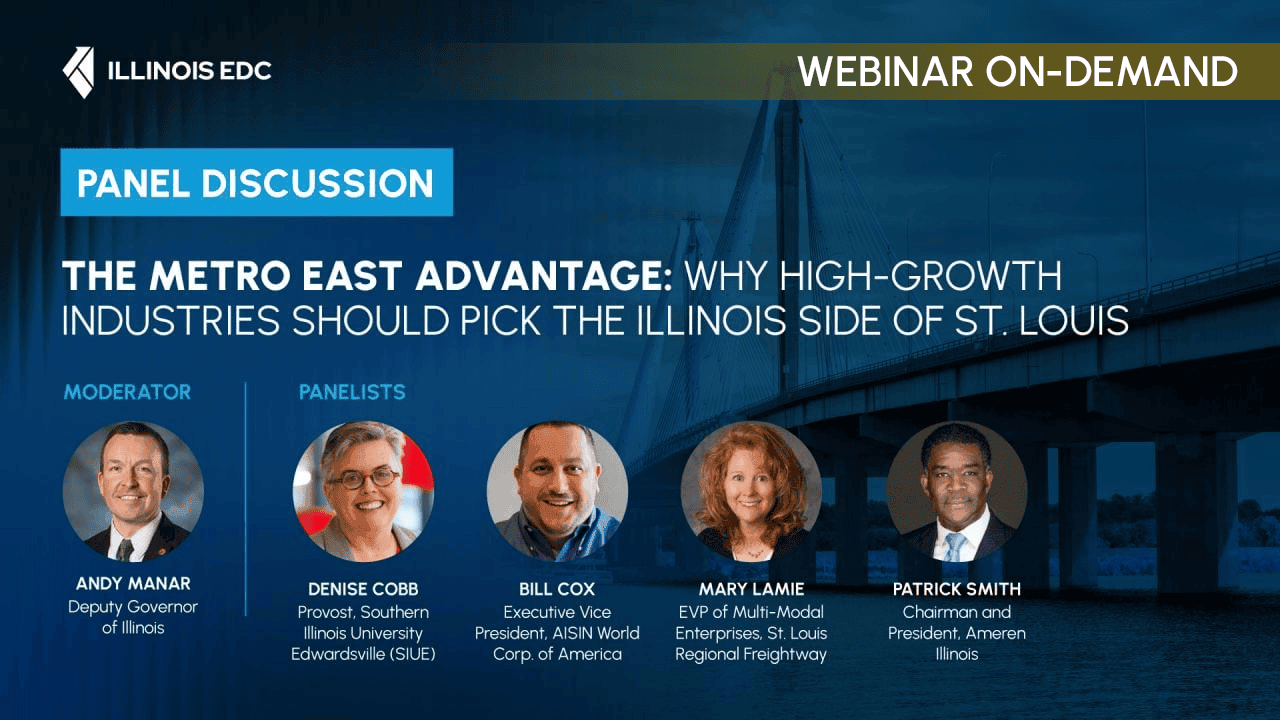
Ask a site selector to picture the Illinois side of St. Louis, and too many still see flat farmland. Illinois EDC’s recent webinar, The Metro East Advantage: Why High-Growth Industries Should Pick the Illinois Side of St. Louis, set out to change that picture—thanks to the people building there right now, from academia to government to industry.
We brought together a panel of the people who know the region best: state leadership, higher education, global manufacturing, freight logistics, and energy. Together, they make the case that Southwest Illinois is a top-tier destination to live, work, and do business.
👉 Didn’t get a copy of the companion white paper? Download it now for the complete data backing our conversation.
Meet the Experts
- Andy Manar: Deputy Governor, State of Illinois (moderator)
- Denise Cobb: Provost, Southern Illinois University Edwardsville (SIUE)
- Bill Cox: Executive Vice President, AISIN World Corp. of America
- Mary Lamie: Executive Vice President of Multimodal Enterprises, St. Louis Regional Freightway
- Patrick Smith: Chairman and President, Ameren Illinois
Setting the Stage: A Region Accelerating
Opening the conversation, Deputy Governor Andy Manar framed the Metro East as a live example of Illinois’ broader economic strategy—one where the state, regional partners, and private industry are working from the same playbook to win high-growth investment, “tripling down in infrastructure commitments for long-term economic growth.”
It’s a strategy boosted by the data to prove it: R&D employment across the Metro East is growing 9.5% year over year, and the advanced manufacturing workforce has expanded to more than 56,000 skilled workers—up from 48,000 just a few years ago.

Manar emphasized Illinois’ high rankings in CNBC’s Top States for Business: 5th in the U.S. for college readiness and 3rd for education. “My experience in this role is, after we sit down with a company, nine times out of 10, we hear a version of, ‘Wow, I didn’t know that about Illinois. I didn’t know you did that; I didn’t know that was there; I didn’t know you could do that.’ If you’re looking to invest, give us a shot.”
The Talent Pipeline: SIUE’s Role in Building the Workforce
For companies weighing an expansion, labor availability is often the deciding factor. Denise Cobb, provost of SIUE, spoke to how the university is building that pipeline proactively—exemplified by University Park at SIUE. The site, an Illinois EDC Vetted Site, is a 330-acre technology and research park in an advantageous location, where private companies plant roots alongside academic researchers and benefit from the region’s engineering, biotech, and computer science programs.
This strategic site, driving biofuel commercialization, agriculture, and pharmaceutical science, “can power the companies who choose it,” further amplified in strength and resilience “by partnerships with Ameren, Illinois EDC, and others,” she said.
“Great communities have great universities. Our chancellor, Dr. [James T.] Minor, often reminds us how important that synergy is. SIUE is really driving the workforce of today and tomorrow. We have been the largest producer of baccalaureate degrees over the last 10 years in the larger St. Louis region, and I think it’s important as I’m sitting in rooms in Illinois to remind people that this is the 2nd largest MSA in the state of Illinois, and to remind people in St. Louis what a tremendous opportunity for them it is to partner with SIUE, our community colleges, and other higher education institutions.”

“One of the assets that we have are the people and the talent that comes out of universities and out of our higher education partners. When you look at our graduates in particular, 60% of our alumni live in the region, and they want to make a difference in their communities. They are committed to living, working, playing, and driving the betterment of this region and state. I think that’s true for coming generations, so making sure that we’re in a position to retain talent and drive talent to our industry partners is such a great opportunity and we stand ready to partner with anyone who is ready to be part of those kinds of opportunities.”
The conversation that bridges the talent pipeline with local companies is two-way; the university is “deeply reliant on industry partners and advisors to help shape what happens next,” which allows the system to meet the needs of its regional employers.
A Global Manufacturer’s Perspective: Why AISIN Succeeds Here
Few voices carry more weight than the companies already operating on the ground. Bill Cox, executive vice president of AISIN World Corp. of America, offered that perspective directly—what it actually looks like to run a global manufacturing operation from the Illinois side of the river, and why the fundamentals (workforce, supply chain, cost base) keep paying off.
In referring to what sets Illinois apart: “People. Partnership. Opportunity. We have skilled workforce as far as the people go, a great, supportive business climate as far as the partnership goes with local and state government, and opportunity. We’re globally competitive, and we’re definitely competitive in the United States.”

AISIN’s success, in part, has been due to the “excellent collaboration with state and local governments…those partnerships make it easy to know exactly what Illinois brings to the table. State, utility, and industry is a three-pronged approach,” and “transparency” is the rising tide which lifts all boats.
Moving Product to Market: The Freight Advantage of America’s ‘Ag Coast’
The Metro East’s multimodal network is one of its most-cited assets, and Mary Lamie, executive vice president of multimodal enterprises at the St. Louis Regional Freightway, is one of the sharpest voices on why it matters. Illinois’ “status as a global logistics hub” is due to its geographic advantage (with a central location offering access to 86% of the continental U.S. population via two-day truck drive, for example), cost-effective multimodal infrastructure (with rail connecting the East Coast to the West Coast and the Midwest to Canada), and a truly unmatched talent pool.
In our companion white paper, Lamie explained why the region’s veteran talent pool out of Scott Air Force Base is such a differentiator for logistics and defense-adjacent employers: “They arrive with two assets the private sector struggles to source: active security clearances and rigorous technical discipline.”

“It’s really the private and public sector leaders working together to set infrastructure priorities, partnerships that are creating the pipeline for our job-ready labor force, and a set collaboration that’s really helping us streamline that site selection process. It’s a combination of our geographic location and multimodal infrastructure that’s providing manufacturers warehousing operations and logistics providers that competitive advantage.”
Further, the region’s availability of rail-serve sites—16 out of 21 of them are in the Metro East—and large-scale, developer-ready sites with barge service (the cheapest mode of transportation), offer companies an incredible opportunity to stake their claim early in a burgeoning landscape. It’s the “most strategic location on the Mississippi River in the Midwest,” hence its ‘Ag Coast of America’ nickname.
“Our region functions in this way: Companies have the ability to move commodities from barge to train or barge to truck—critical regarding supply chain disruption. It provides stabilization of cost. Additionally, aerospace companies [such as Boeing, Gulfstream Aerospace Corporation, and West Star Aviation] are all based at regional airports and support high-paying jobs.”
Powering Growth: The Energy Infrastructure Behind the Boom
None of this works without reliable power—and few companies understand that better than Ameren Illinois. Patrick Smith, chairman and president and Illinois EDC board member, spoke to how the utility is investing ahead of demand to make sure the grid can support the next wave of advanced manufacturing, life sciences, and aerospace growth in the region.
When it comes to “utility as a partner in Illinois, we understand both emerging and legacy industries are energy-intensive, and energy is a front-end requirement for growth. When an organization is evaluating a community, they want to know about access, scalability, and affordability of energy to that area…and Ameren provides energy certainty.”

“Site readiness is a force multiplier for economic development. One of the main incentives for businesses to locate here is that what they need to be successful, what they need to launch, is ready to go. That’s what ASAP is—Ameren Site Acceleration Program—and we’re looking forward to great impact in the future.”
Key Takeaways
- Research momentum is accelerating: R&D employment is up 9.5% year over year; scientific and technical consulting is up 7.5%.
- The workforce keeps growing: Advanced manufacturing employment has climbed from 48,000 to more than 56,000 workers since 2023.
- Scott Air Force Base is a force multiplier: More than 39,000 retired military personnel in the surrounding area feed a talent pipeline sustaining 330,000+ jobs tied to aerospace manufacturing and its supply chain.
- The freight network has few peers: The region sits at the confluence of all six Class I railroads, four interstates, and America’s Central Port—a direct, congestion-free water pipeline to the Gulf of Mexico.
- The cost base surprises executives: Housing affordability and a lower cost of living give employers a real edge in attracting and retaining talent.
- It’s a true ecosystem of collaboration: From SIUE’s workforce pipeline to Ameren’s infrastructure investment to the state’s own economic strategy, the Metro East’s advantage comes from every lever pulling in the same direction.
Missed the live conversation? The full panel discussion—including the complete Q&A—is available to watch on demand here.
Want the full picture? Download the white paper for the data to back this up.
Ready to Explore the Metro East Advantage for Your Business?
If your company is weighing its next move, our team can walk you through what the Metro East advantage looks like for your specific industry, from site selection to workforce data to incentive navigation—all at zero cost. Connect with us today.
About Illinois EDC
The Illinois Economic Development Corporation is the statewide economic development organization focused on bringing new businesses, jobs, and investment to Illinois. Since 2016, Illinois EDC has helped create more than 21,000 jobs and generate nearly $12 billion in new investment.
RELATED POSTS