
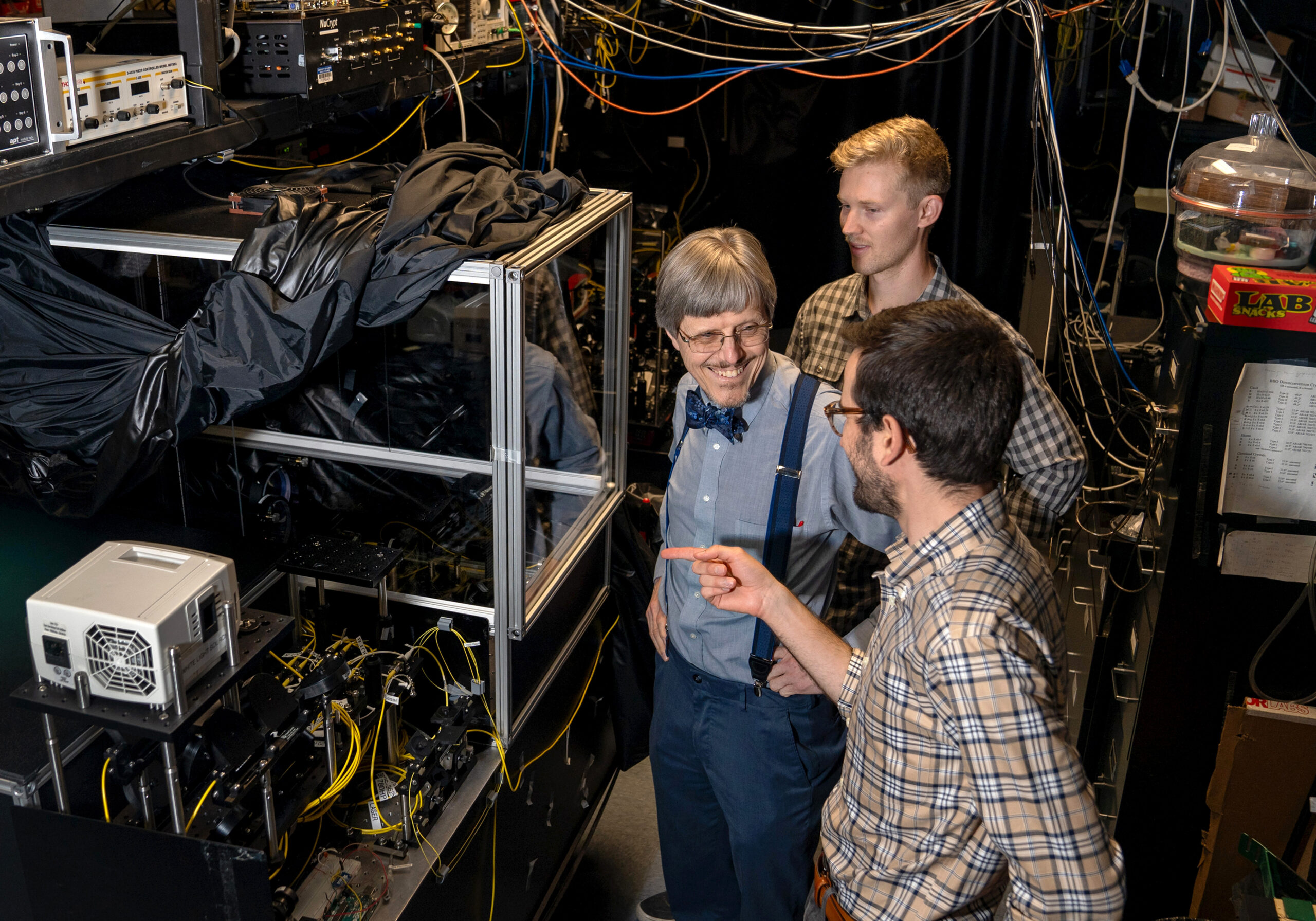
Physicist Paul Kwiat, far left, and graduate students Colin Ludali and Nathan Arnold in the Kwiat Quantum Information Lab at the University of Illinois Urbana-Champaign (2024). Photo courtesy of UIUC.
Welcome to the second installment of the Data Detective series from Illinois EDC’s Research Team! As the year draws to a close, it’s a perfect time to reflect on the International Year of Quantum and explore how Illinois is positioning itself as a hub for quantum innovation.
How to Use IPEDS to Compare Talent in Number of Program Completions
Illinois boasts a robust talent pipeline, and we at Illinois EDC often tout that the state produces more engineering graduates than Caltech, Stanford, and MIT combined. But how do we actually verify that claim? The answer lies in public data, which can be found in the Integrated Postsecondary Education Data System (IPEDS). Follow this guide to discover the data (or investigate another set!) for yourself:
- Access IPEDS
Start by visiting the IPEDS Data Center. This is your gateway to detailed higher education data in the U.S.
- Use the Data Explorer
At the top of the page, click Use The Data and select Custom Data Files. This tool lets you build a dataset using specific educational data variables tailored to your research needs.
- Select Institutions
In the first tab, Select Institutions, choose By Names or UnitIDs. For this comparison, we’ll input:
- University of Illinois Chicago
- University of Illinois Springfield (note: Springfield doesn’t offer engineering programs, but is included here as part of the U of I System)
- University of Illinois Urbana-Champaign
- California Institute of Technology
- Massachusetts Institute of Technology
- Stanford University
- Choose Variables
Once you’ve entered your institution of choice, move to the second tab, Select Variables. The most recent year will be automatically selected (in this instance, we are using 2024). Scroll down and click Completions to expand the section: Awards/degrees conferred by program (CIP), award level, race/ethnicity, and gender: July 1, 2023 to June 30, 2024.
For qualifying variables, select the following:
- First Major and Second Major (then click Save)
- CIP Code 14 (Engineering) under the 2020 CIP Classification (then click Save)
- For Award Level code, select all degree levels (Associate’s degree through Doctor’s degree – other). Then click Save.
Under Race/Ethnicity and Gender, select Grand Total to capture all completions.
- Output and Download
Click the Output tab and download the data in CSV format. This file contains the raw numbers you need.
- Analyze the Data
Once you’ve downloaded the CSV file, the next step is to aggregate the completions for the University of Illinois campuses and compare them to Caltech, MIT, and Stanford. The results are striking: The University of Illinois system produced 10,656 engineering graduates in 2024, while MIT, Caltech, and Stanford combined accounted for only 8,028 graduates. In fact, UIUC alone graduated 8,217 engineers, surpassing the combined total of these three elite institutions!
Key Takeaway
Illinois’ universities are fueling the next generation of quantum scientists and engineers, creating a competitive advantage for companies and research institutions looking to innovate within the state. Illinois is producing talent and scale with a depth of engineering expertise that makes Illinois the ideal location for quantum investment, research, and commercialization. Until next time!
Get Curious
What data would you like our Research Team to tackle next? Let us know, and we’ll get to sleuthing.
RELATED POSTS