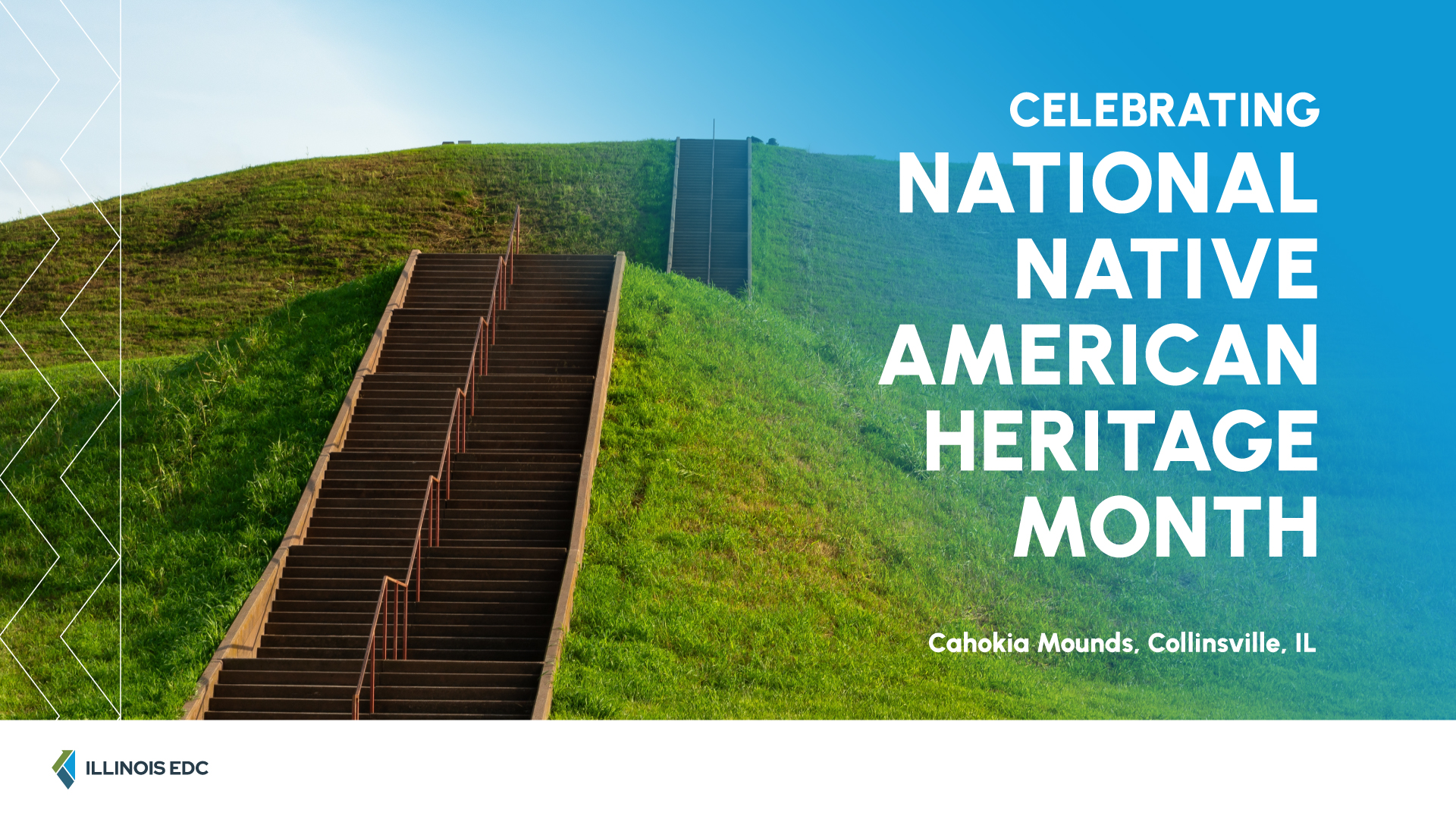
November is National Native American Heritage Month—a time to honor the histories, cultures, sovereignty, and enduring contributions of American Indian and Alaska Native peoples across the country. In Illinois, that celebration carries particular weight: The state is home to one of the most tribally diverse urban Native populations in the United States, a rich landscape of Indigenous cultural institutions, and a growing community of Native-owned businesses making their mark on Illinois’ economy.
At Illinois EDC, we recognize that the land we work on has always been home to Native peoples—and that American Indian and Alaska Native communities continue to shape Illinois’ cultural and economic life today. This month, we celebrate that legacy and the entrepreneurs, artists, advocates, and civic leaders carrying it forward.
By the Numbers: Illinois’ Native American Business Community
Illinois is home to 271,494 American Indian and Alaska Native residents—representing 2.1% of the state’s total population of 12.7 million (U.S. Census, 2024 ACS 5-Year Estimates, Race Table B02001; includes individuals identifying as American Indian and Alaska Native alone or in combination with one or more other races).
The economic footprint of Illinois’ Native American community reflects both its resilience and its opportunity:
- 9,241 Native American-owned employer and nonemployer firms in Illinois—including 7,500 nonemployer firms and 1,741 employer firms (out of 1,358,091 total Illinois firms statewide)
- $1.77 billion in sales generated by Native American-owned employer and nonemployer firms (U.S. Census, Nonemployer Statistics by Demographics series, 2023)
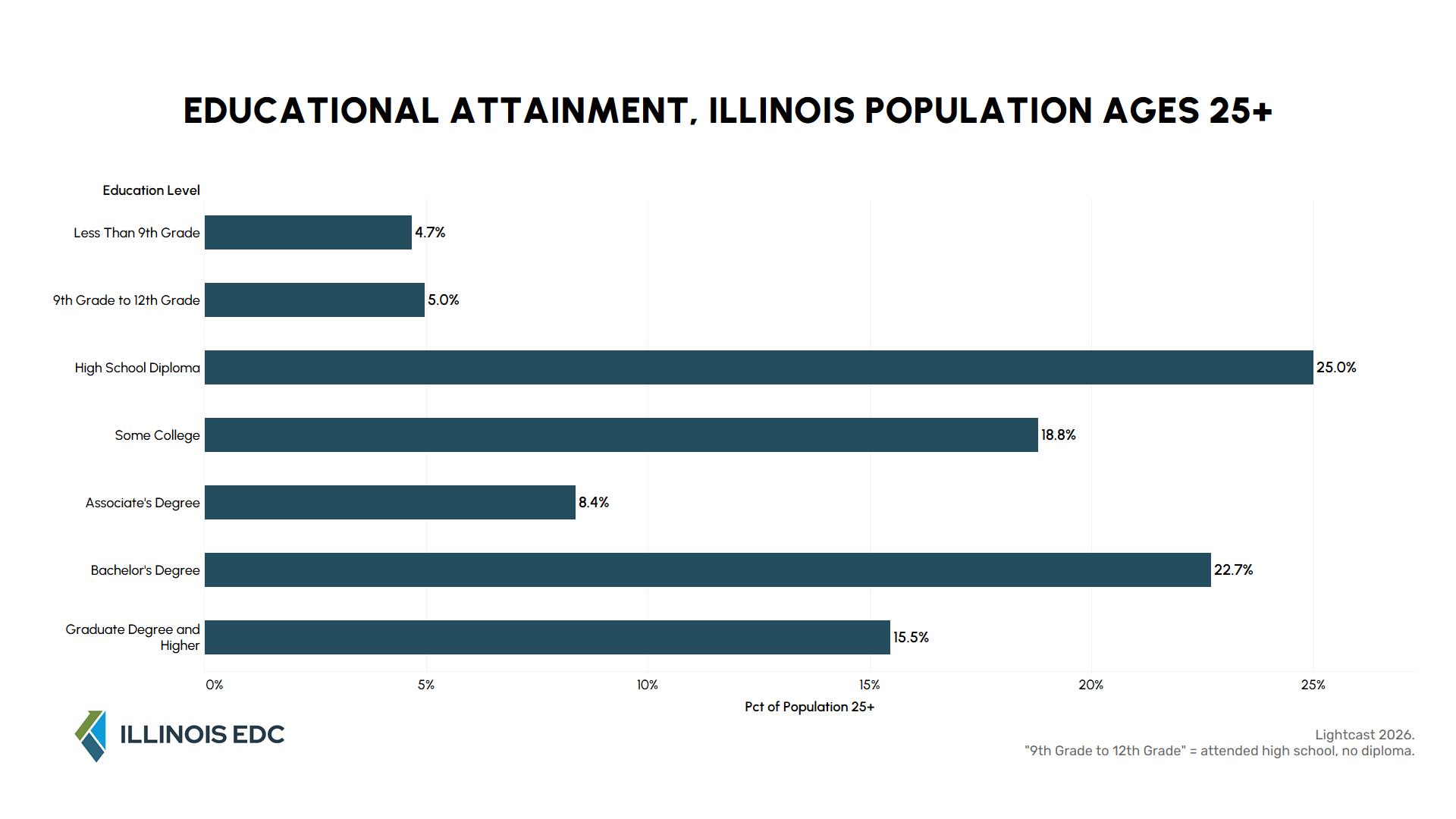
- 24.9% of Illinois’ Native American population holds a bachelor’s degree or higher, compared to 36.8% statewide—a gap that points to ongoing opportunity to invest in Native educational pathways and economic mobility
- Illinois Native American residents have a median household income of $78,582, compared to $81,604 statewide (U.S. Census, Selected Population Profile, 2024 ACS 1-Year Estimates)
As with all demographic data, these figures reflect a portion of a larger, more complex picture. Federal census categories don’t always capture the full range of community identity and self-identification—a reminder that behind every number are real individuals, families, and stories shaping Illinois.
A Historical Note: Chicago’s Urban Native Community
To understand Illinois’ Native American community today, it helps to understand how it was shaped. From 1952 to 1972, the federal Bureau of Indian Affairs ran a voluntary relocation program—formally authorized by the 1956 Indian Relocation Act—that encouraged Native peoples to leave reservations for cities like Chicago, Detroit, Los Angeles, and Seattle. Roughly 8,000 Native Americans moved to Chicago beginning in the 1950s, settling primarily in the Uptown neighborhood on the city’s North Side.
The program is a key reason Chicago’s Native community is so tribally diverse. People continued moving to the city after relocation ended in 1972, and many of the organizations that exist today—including the American Indian Center, founded in 1953—grew directly out of this era.
That history is also the context for the community’s extraordinary resilience: urban Native communities built their own institutions, preserved their cultures, and created pathways to economic opportunity with limited outside support. The organizations and leaders highlighted in this post are the direct inheritors of that tradition.
Notable Native American-Led Businesses in Illinois
Illinois is home to a growing number of Native American-owned businesses across engineering, construction, technology, defense, and food:
- Bodwé WBK Engineering: With an office in St. Charles, Bodwé Professional Services Group is a tribally owned collection of companies under the Pokagon Band of Potawatomi providing architecture, engineering, planning, and consulting services across the full built-environment life cycle—from predevelopment through design, construction, and operations. Bodwé’s work is guided by the Pokagon Seven Generations philosophy, reflecting a deeply rooted understanding of long-term stewardship of the land and community.
- Akana: A Native American-owned firm dedicated to the Three Affiliated Tribes (Mandan, Hidatsa, and Arikara Nation), whose CEO Herb Fricke is a tribal member. Akana provides construction, construction management, and inspection services for public infrastructure projects across the Puget Sound and Chicago areas, along with civil, structural, mechanical, and electrical engineering services for federal, state, municipal, and tribal clients.
- Vista Defense Technologies LLC: A Native American-owned company with a secondary office in Rock Island, providing IT and government services across health, military, cybersecurity, and research and development. Vista is a subsidiary of Bristol Bay Native Corporation, an Alaska Native Corporation with over $2 billion in assets and operations spanning government services, construction, industrial services, and tourism.
These companies reflect the breadth of Native entrepreneurship in Illinois—from deeply rooted tribal enterprises guided by Indigenous values to high-growth technology and infrastructure firms competing for federal and commercial contracts.
Notable Native American Illinoisans
Across civic leadership, arts, literature, financial advocacy, and public service, Native Americans have made enduring contributions to Illinois and the nation:
- Andrew Johnson — A member of the Cherokee Nation and executive director of the Native American Chamber of Commerce of Illinois, Johnson chairs the Native American Employment Plan Advisory Council. He previously served as executive director of the American Indian Center of Chicago and was instrumental in advancing legislation requiring Illinois schools to teach Native American curriculum beginning in the 2023–24 school year.
- Melodi Serna — Executive director of the American Indian Center of Chicago, Serna is a member of the Turtle Mountain Band of Chippewa Indians and the Oneida Nation and chairs the Citywide American Indian Education Council with Chicago Public Schools. Born and raised in Chicago, she continues a family legacy of Native community leadership—her mother served as executive director of the Center during Serna’s childhood. Under her leadership, the center received a three-year federal grant of $1,006,755 for its Food is Medicine project.
- Jessica Pamonicutt (Walks First) — Born into the Menominee Indian Tribe of Wisconsin and raised in Chicago, Pamonicutt is the owner of Ketapanen Kitchen, where she brings Indigenous cuisine, cultural history, and community together around the table. An educator, activist, and advocate, she offers classes, cultural presentations, kitchen takeovers, and private chef services that connect guests to the history and knowledge behind what they eat.
- Chantay Moore — A member of the Navajo Nation, Moore provides financial literacy workshops to Native American communities across the country. In 2019, she launched Native American Financial Literacy Services (NAFLS) to address the specific educational and financial empowerment needs of Native communities, and owns a financial planning practice with WealthWave. She also serves on the board of the American Indian Center of Chicago.
- Pamala Silas — A member of the Menominee Indian Tribe and associate director of Northwestern’s Center for Native American and Indigenous Research, Silas has led the National American Indian Housing Council and the Native American Journalists Association. In 2020, Governor Pritzker appointed her to the state’s first Native-focused advisory council, the Native American Employment Plan Advisory Council.
- Mark Turcotte — Named Illinois’ sixth Poet Laureate in 2025, Turcotte began a four-year term promoting literary access and statewide community engagement. He arrived in Chicago in 1993 and won the first Gwendolyn Brooks Open-mic Poetry Award that year. His books include The Feathered Heart and Exploding Chippewas, and he is a distinguished writer in residence at DePaul University.
- Elise Paschen — Born and raised in Chicago, Paschen co-founded Poetry in Motion, which brings poetry to public transit systems, and previously served as executive director of the Poetry Society of America. Her collections include Infidelities and Blood Wolf Moon (2025), exploring family history and cultural heritage. She teaches in the MFA Writing Program at the School of the Art Institute of Chicago.
- Joy Harjo — Though born in Oklahoma, Harjo taught at the University of Illinois Urbana-Champaign from 2013 to 2016 and was connected to its American Indian Studies Program. She went on to serve three terms as the 23rd U.S. Poet Laureate (2019–2022)—the first Native American to hold the title—and has received the National Humanities Medal and the 2024 Frost Medal.
- Willard LaMere (1918–1990) — A Native American community organizer and educational leader in Chicago during the mid-twentieth century, LaMere was among the lead organizers of the landmark 1961 American Indian Chicago Conference, which brought together 460 American Indians representing 90 tribes and produced the “Declaration of Indian Purpose,” presented to President John F. Kennedy in 1962. His work helped found institutions that expanded Native communities’ self-determination and quality of life in Chicago.
Organizations Supporting the Native American Community in Illinois
Illinois’ Native American ecosystem is supported by a network of organizations spanning business development, health, education, cultural preservation, and community advocacy:
- Native American Chamber of Commerce of Illinois (NACC-IL) — Based in Oak Brook, NACC-IL connects American Indian entrepreneurs, business owners, Tribal leaders, academics, and government officials to expand businesses and strengthen a chamber tailored to Native communities’ needs, cultures, and perspectives. It is backed by the University of Chicago Booth School of Business and assists Native entrepreneurs through the full business journey—from launch through financing, marketing, and fiscal sponsorship.
- American Indian Center — Established in 1953, the American Indian Center is one of the nation’s oldest urban Native centers. It supports fellowship among Native people from all Tribal nations across the Chicago metropolitan area; promotes community welfare and economic advancement; and sustains Native cultural, historical, and artistic traditions.
- American Indian Association of Illinois (AIAI) — A Chicago-based educational nonprofit that supports students through tutoring, college advising, and financial aid assistance. Its Medicine Shield Indian School program connects academic support with Native arts, culture, and language learning. AIAI also preserves and shares Native traditions through the Chicago American Indian Museum Without Walls and the Black Hawk Performance Company.
- Chicago American Indian Community Collaborative (CAICC) — Established in 2012, CAICC brings together Native American organizations working to improve conditions for Native communities in Chicago, supporting shared planning, stronger nonprofit partnerships, leadership development, and economic opportunity.
- American Indian Health Service of Chicago (AIHSC) — Provides culturally based healthcare to American Indian and Alaska Native communities and other underserved populations in the greater Chicago area, including medical and behavioral health services, wellness programming, and assistance with Medicaid and health insurance enrollment.
- Native American House, University of Illinois Urbana-Champaign — Founded in 2002, this university Student Affairs program supports student belonging, wellbeing, and retention through academic support, engagement, and advocacy, while encouraging a fuller understanding of contemporary Indigenous cultures and communities across central Illinois.
- Trickster Cultural Center (Schaumburg) — Located in Schaumburg in the Chicago metropolitan area, Trickster offers contemporary Indigenous art exhibitions, school tours, educator workshops, and programming honoring veterans. Its first-voice educational approach connects visitors with present-day cultural expression.
- Cahokia Mounds Museum Society (Collinsville area) — Established in 1976, this nonprofit supports Cahokia Mounds State Historic Site through land protection, archaeological research, and educational programming, including lectures, nature and culture hikes, youth activities, and markets where Native artists can share and sell their work.
Grants and Community Investment
Illinois’ Native American organizations are supported by a range of philanthropic and government funding sources:
- MacArthur Foundation — Awarded $100,000 to the American Indian Center to support food distribution for residents across Chicago and the surrounding metropolitan area.
- Administration for Native Americans — In 2022, the American Indian Center of Chicago received a three-year, $1 million grant through the agency’s Social and Economic Development Strategies program to support its Indigenous food sovereignty project.
- Native Voices Rising (2025) — Named the American Indian Center of Chicago and the Mitchell Museum of the American Indian in Evanston among its 2025 grant partners, highlighting philanthropic support for Native-serving organizations in the Chicago area.
- Illinois IDHS Healing Illinois (2026) — Listed the American Indian Center of Chicago and Trickster Cultural Center among the 204 organizations participating in its 2026 grant program, representing state-level investment in Native-serving cultural organizations.
- Landmarks Illinois Preservation Heritage Fund (2025) — Awarded $5,000 to the National Trail of Tears Association in Buncombe, in southern Illinois, for critical repairs to the historic Wayside Store at the Trail of Tears Encampment—a site connected to the history of forced removal.
- Illinois State Historical Records Advisory Board (2026) — Awarded $5,000 to the University of Illinois to organize and digitize archaeological spatial data from past excavations at Cahokia, supporting research, preservation, public interpretation, and compliance decisions by Descendant Tribal Nations.
Illinois’ Native American Heritage: In Our Place Names
The influence of Native American peoples on Illinois runs deeper than history—it’s woven into the names of the state’s counties, rivers, and cities:
- Iroquois County — Named for the powerful Iroquois Confederacy, whose influence extended far beyond their northeastern homeland.
- Kankakee County — Named after the Kankakee River, from a Miami-Illinois word; the river was a vital Indigenous transportation and trading route long before European settlement.
- Macoupin County — Named after the macoupin, a Native word for a water plant whose nutritious tubers were harvested by Indigenous peoples as a food source.
- Peoria County — Named for the Peoria Tribe, one of the tribes of the Illiniwek Confederation that lived throughout central Illinois.
- Sangamon County — From a Potawatomi word meaning “where there is plenty to eat,” reflecting the region’s rich natural resources that sustained Native communities for generations.
- Wabash County — Named after the Wabash River, derived from a Miami word describing the clear water flowing over pale limestone riverbed.
- Winnebago County — Named for the Winnebago (Ho-Chunk) Nation, whose history spans Wisconsin, Illinois, and neighboring states.
And the names we use every day: Illinois itself comes from the Illiniwek, a confederation of Native tribes who lived throughout the region—French explorers adapted the Native name, and it became the name of the state. Chicago comes from a Miami-Illinois word for the wild onion or leek that grew along the river, making the very name of Illinois’ largest city an enduring piece of Indigenous heritage.
Heritage Site to Know: Cahokia Mounds State Historic Site (Collinsville)
About 1,000 years ago, Mississippian peoples built Cahokia in what is now southwestern Illinois. At its peak around 1100 A.D., the region was home to an estimated 10,000 to 20,000 people—at the time, more than London. The 2,200-acre site became an Illinois state historic site in 1923 and is now one of 24 UNESCO World Heritage Sites in the United States, as well as a National Historic Landmark listed on the National Register of Historic Places.
Sometimes called “America’s First City,” Cahokia is a powerful reminder that Illinois’ history of settlement, innovation, and community is far older than statehood.
Celebrate Native American Heritage Month in Illinois
Looking to honor and connect with Native American Heritage Month across Illinois? These resources are a great place to start:
- Native American Heritage in Illinois | Enjoy Illinois — Explore Native Truths: Our Voices, Our Stories, the Field Museum’s permanent exhibition featuring Indigenous storytelling, art, and cultural perspectives.
- Native American Heritage in Illinois’ Landscapes | Enjoy Illinois — Walk the trails at Casper Bluff Land and Water Reserve near Galena to learn about ancient Native American mounds overlooking the Mississippi River.
- Native American Heritage Month | Illinois DCEO — Overview of financial resources for Native American small businesses, including government and private-sector funding resources.
- First Nations Film and Video Festival | Choose Chicago — Free screenings of films by Indigenous directors, held at Chicago-area venues in May and November.
- Center for Native Futures | Choose Chicago — Explore contemporary Indigenous art in downtown Chicago.
- Portage Park | Chicago Park District — Visit the site of the historic canoe portage connecting the Chicago and Des Plaines Rivers, a lifeline for Indigenous peoples long before the city existed.
- Chicago Public Library — Explore Native American Heritage Month programming at branches across the city.
Grow With Us
For Native American-owned businesses and companies committed to working with Indigenous communities, Illinois offers:
- A diverse, growing ecosystem of Native-owned enterprises across construction, engineering, technology, food, and cultural services
- Proven public-private support programs, including EDGE and EDGE for Startups tax credits
- Access to capital, certification pathways, and chamber networks through NACC-IL and partner organizations
- A state that is actively investing in Native communities—through workforce legislation, cultural preservation grants, and educational curriculum
Interested in learning more about Illinois for your company? Get in touch with our team today.
RELATED POSTS