As we continue celebrating National Arab American Heritage Month, it’s a great honor to shine a light on our next Economic Driver: Aneesa Muthana, CEO of Pioneer Service, Inc. and M&M Quality Grinding. Her story sits at the intersection of manufacturing, family, faith, and service. In her feature, she emphasized that, as a proud Yemeni-American woman in manufacturing leadership, her work is “about more than running a business….it’s about creating opportunity, serving the community, widening the picture of who leadership can look like, and showing that when challenges come, you do not play the victim—you keep moving and find plan B.”
How long have you lived and worked in Illinois?
Lived my whole life—56 years. Worked—since the age of 11 (45 years ago).
What inspired your career path and industry involvement?
I grew up in manufacturing. My parents came to the United States from Yemen and built a life through hard work, and I got my start in their shop, M&M Quality Grinding. That shaped me early. I saw what it meant to build something from the ground up, take responsibility, and create opportunity for others. In my early 20s, I left the family business and became CEO and co-owner of Pioneer Service. I was young, I was a woman in a male-dominated industry, and I knew I would have to prove myself through discipline, results, and consistency. Manufacturing appealed to me because it is real. You make things, solve problems, build teams, and earn trust through performance. Over time, my involvement in the industry grew beyond my own company. I wanted to help strengthen manufacturing, support the next generation, and challenge assumptions about who belongs in leadership. That has led me to industry boards, speaking, and advocacy around leadership, workforce, and practical inclusion. At the center of it, my path was inspired by family, responsibility, and a belief that manufacturing still offers one of the clearest ways to build something meaningful.
As an Arab American leader in your field, what challenges have you faced, and how have you overcome them?
As an Arab American woman in manufacturing, I have had to deal with assumptions from the start. Some people underestimated me because of my background, some because I was a woman in a male-dominated industry, and some simply were not used to seeing someone like me in leadership. Early on, I learned that I could not spend my energy trying to win everyone over. I had to focus on competence, discipline, and results. I built credibility by knowing the business, making hard decisions, staying consistent, and holding a high standard for myself and the people around me. I have also had to push past stereotypes—not by arguing with every one of them, but by living in a way that challenged them. I am proud of my Arab heritage, proud to be Muslim, and proud of the life my family built through hard work. I have tried to lead in a way that reflects that—with conviction, accountability, and respect for others. Over time, I stopped seeing those challenges only as obstacles. They also gave me perspective, resilience, and a stronger sense of purpose. They made me more determined to lead well, to open doors for others, and to show that you do not have to fit someone else’s mold to build a meaningful career and make an impact.
Can you share a key moment in your career that shaped who you are today?
Yes. One of the biggest turning points in my career was leaving my family’s business in my early 20s to become CEO and co-owner of Pioneer Service. I was young, stepping into a demanding industry, and taking on a level of responsibility that forced me to grow fast. I had to learn how to lead, make hard decisions, earn credibility, and carry the weight of a business in a way that was very real. That experience shaped my confidence, my discipline, and my understanding of leadership. Another defining moment came years later when I returned to my family’s company, M&M Quality Grinding, as co-owner and CEO. Coming back to where I started gave me a deeper appreciation for my parents’ sacrifice, the foundation they built, and the responsibility of carrying that legacy forward while still leading Pioneer. Those moments shaped who I am today because they taught me that leadership is not about title or image. It is about responsibility, resilience, and being willing to do hard things when they need to be done.
Who are (or have been) some of your mentors, role models, or inspirations?
My parents have been among my biggest inspirations. They came to this country from Yemen with nothing, built a life through hard work, and gave me my first exposure to manufacturing. They taught me, by example, what sacrifice, grit, and responsibility look like. My mother has especially stayed with me as a source of strength. She spent her life in manufacturing without recognition or attention, but with real endurance and commitment to her family. That kind of quiet strength leaves a mark. As a businesswoman, I have also always been inspired by Khadija (RA). She was a wife, a mother, and a successful businesswoman long before people used terms like that. She used her position, influence, and financial means to support something bigger than herself and to do good. That example has always meant a lot to me because it reflects strength with purpose, success tied to character, and the idea that leadership should serve something beyond your own gain. I also respect leaders who are grounded, capable, and accountable—people who build strong organizations, make hard decisions, and stay steady through challenges. Those are the examples that have shaped how I try to lead.
What does success look like to you—professionally and/or personally?
Success to me is being effective in the areas that matter most. Professionally, it means building strong companies that do good work, create opportunity for people, and earn trust over time. It means making smart decisions, developing people, serving customers well, and leaving the business better than I found it. Growth matters, but growth by itself is not enough. I care about the quality of what we are building, the kind of culture we create, and the kind of leadership we show along the way. Personally, success means staying grounded in my faith, being present for my family, and knowing that the people closest to me have not been pushed aside in the process of building a career. I have five grandchildren, and being part of their lives means a great deal to me. Success is being able to lead, contribute, and still make room for what matters most at home. At this stage of my life, success is less about recognition and more about impact. It is about doing meaningful work, helping others grow, and being able to look at your life and know you did some good with what you were given.
How does being in Illinois contribute to your success as an Arab American leader (if it does)?
Yes, Illinois has contributed to my success. Illinois has a strong manufacturing base, and that matters. It gave me the chance to build and lead in an industry that is still a real part of the state’s economy, not an afterthought. It also puts you in a business environment where hard work, production, supply chains, and skilled trades are understood and respected. Illinois EDC itself frames the state around business connections, industry access, and support for companies growing here. It has also helped that Illinois is home to a large and active Arab American business community. There are organizations here, including the American Arab Chamber of Commerce of Illinois, that reflect the presence and contribution of Arab American professionals and business owners in the state. And this month, the State of Illinois is publicly highlighting Arab American businesses and entrepreneurs through its Arab American Heritage Month programming. On a personal level, being in Illinois has allowed me to grow a business, raise a family, and lead in a place where industry and community are both part of daily life. So yes—Illinois has played a meaningful role in my success, not because it made things easy, but because it gave me room to build.
What do you love most about living and working in Illinois?
What I love most about living and working in Illinois is the balance it has given me over the years. I loved raising my family in the suburbs, where we had space, community, and a strong foundation. Now, moving into Chicago and waking up to a view of the lake feels like a meaningful new chapter. Illinois has given me the chance to grow a business, stay close to family, and build a life that feels full in every sense.
What makes Illinois a strong place for Arab American business leaders?
Illinois is a strong place for Arab American business leaders because it combines business opportunity with a real sense of community. As a proud Yemeni American, I especially love seeing the visibility of our culture here, including the many Yemeni coffee shops and businesses that have become part of the local fabric. It makes Illinois feel like a place where you can succeed professionally without feeling disconnected from who you are.
What policies, programs, or networks in Illinois have supported your professional growth or your organization’s mission?
Illinois has supported my growth through strong manufacturing and leadership networks. Organizations like IMA, MxD, and IMEC have all helped create access to ideas, relationships, and practical support. More broadly, Illinois has programs and institutions that continue to invest in manufacturing, workforce development, and business growth, and that has helped create a strong environment for companies like ours.
How do you or your organization support your local community or underrepresented groups?
Outreach is one of our core values, so supporting the community is built into our culture. As a company, we take part in at least one community-focused effort each month, including food drives, annual blessing bags, volunteering at Feed My Starving Children, and annual toy drives for LaRabida Hospital. We believe a business should contribute in practical ways, not only through jobs, but through consistent service.
Are there any initiatives or organizations in Illinois that you’re proud to support?
Yes. I’m proud to support organizations that help people in practical ways, including Feed My Starving Children and La Rabida Children’s Hospital. I also value groups like IMA, MxD, and IMEC in Illinois, along with Women in Manufacturing and similar initiatives that help strengthen leadership and support the future of manufacturing.
What inspires you to continue to affect change in your world?
What inspires me is the chance to do some good with what I have been given. I want to build strong businesses, help people grow, and make it easier for others to see themselves in places they may not have expected. My parents’ example, my faith, and the next generation all keep me focused on that.
What does National Arab American Heritage Month mean to you personally?
National Arab American Heritage Month means pride, visibility, and gratitude. It is a time to honor my Yemeni roots, my family’s example, and the many contributions Arab Americans have made to this country and to the communities they help shape every day. It also matters because it gives people a fuller and more accurate view of who we are. In that sense, it is not only about heritage—it is also about representation.
What would you say to a young Arab American professional considering launching or relocating their career to Illinois?
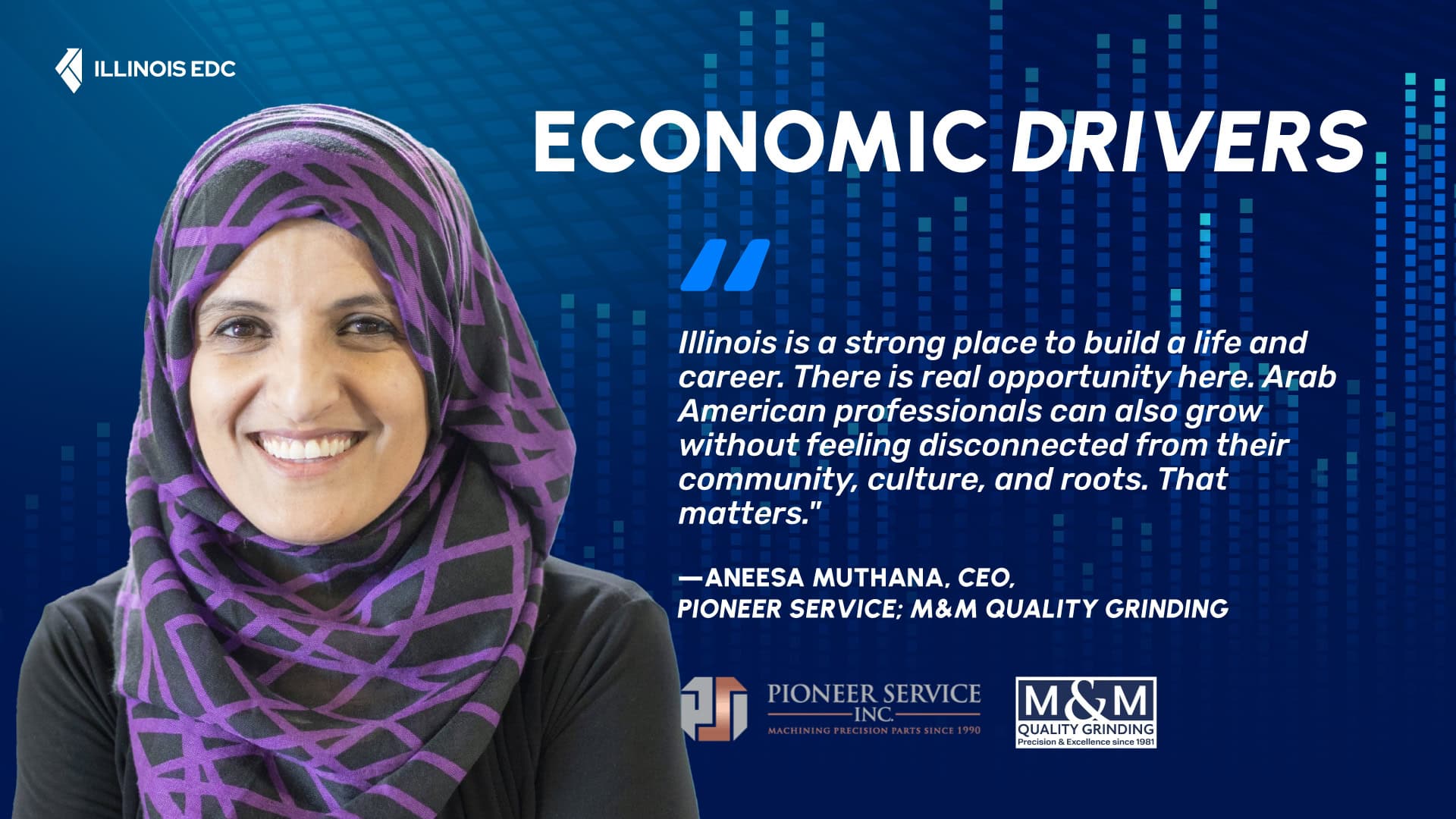
I would tell them Illinois is a strong place to build a life and career. There is real opportunity here for people who are willing to work hard, take initiative, and stay focused on what they can build. Arab American professionals can also grow here without feeling disconnected from their community, culture, and roots. That matters. And like anywhere, success comes easier when you bring a mindset of ownership—staying adaptable, keeping perspective, and moving forward instead of getting stuck in setbacks.
Favorite Illinois historical figure:
Jane Addams—because she put service into action. She did not only talk about problems—she helped build solutions, and she used her position to improve life for others. I respect that deeply.
Favorite book of all time:
Don’t Be Sad by Aaidh ibn Abdullah al-Qarni
Best business advice you’ve ever given (or received):
Simple: Work hard, stay humble, and keep your word.
RELATED POSTS