We’re excited to continue on in our Economic Drivers series by highlighting ComEd President & CEO and Illinois EDC Board Member Gil Quiniones. It’s the final week of May—Asian American, Native Hawaiian, and Pacific Islander (AANHPI) Heritage Month—so take a minute to check out our latest Data Detective, too, for a deep dive into AANHPI immigration into Illinois!
What inspired your career path and industry involvement?
I have always said that electricity is the oxygen of the economy, because without electricity, everything stops. The idea of accepting that responsibility appealed to me, because I like to be close to the action and being part of delivering such a crucial resource—power—to the homes and businesses that depend on it every day. That gives me a sense of purpose and a great deal of satisfaction.
As an AANHPI leader in your field, what challenges have you faced?
When I became a utility CEO there were only a couple other Asian Americans who held that position across the whole industry. So that brings a bit of added pressure—you feel a sense of responsibility to excel not just for yourself but for the next generation of Asian American business leaders.
Can you share a key moment that shaped who you are today?
Less than two years after the 9/11 attacks, Mayor Michael Bloomberg made me the senior vice president for the New York City Economic Development Corporation, responsible for developing policies to strengthen the city’s energy and telecommunications infrastructure, which had been slow to recover from the catastrophic damage of that day. I got to work closely with the people who were making those infrastructure repairs, and I got a sense for how deeply they were driven by purpose. I recognized that their dedication was an outgrowth of how much they cared for their community. Since then, I try to keep communities front of mind to motivate myself—and to help motivate my colleagues. When we know other people are counting on us, it brings out our best.
Who are (or have been) some of your mentors, role models or inspirations?
Mayor Michael Bloomberg for his willingness to hire the best people regardless of party affiliation–he told me to do the same when I filled out my team. He inspired a shared vision and made sure we were clear on our desired outcomes and deliverables. His only bias was in favor of great execution, and I admired that.
What does success look like to you—professionally and/or personally?
I believe relationships are the most valuable quality in our lives, and so success for me is measured by the strength of those relationships. First, with my family. Second, with my closest friends. Having a positive impact on the people who are most important to me, so that I can give them the love and support they give to me. Professional success is also a measure of relationships—with my co-workers who deliver our business strategy, with the key stakeholders making decisions that may determine whether we achieve our desired outcomes, and with the customers and communities who depend on us to power lives. Success means nurturing relationships, demonstrating with both words and actions how valuable they are to me.
How does being in Illinois contribute to your success as an AANHPI leader (if it does)?
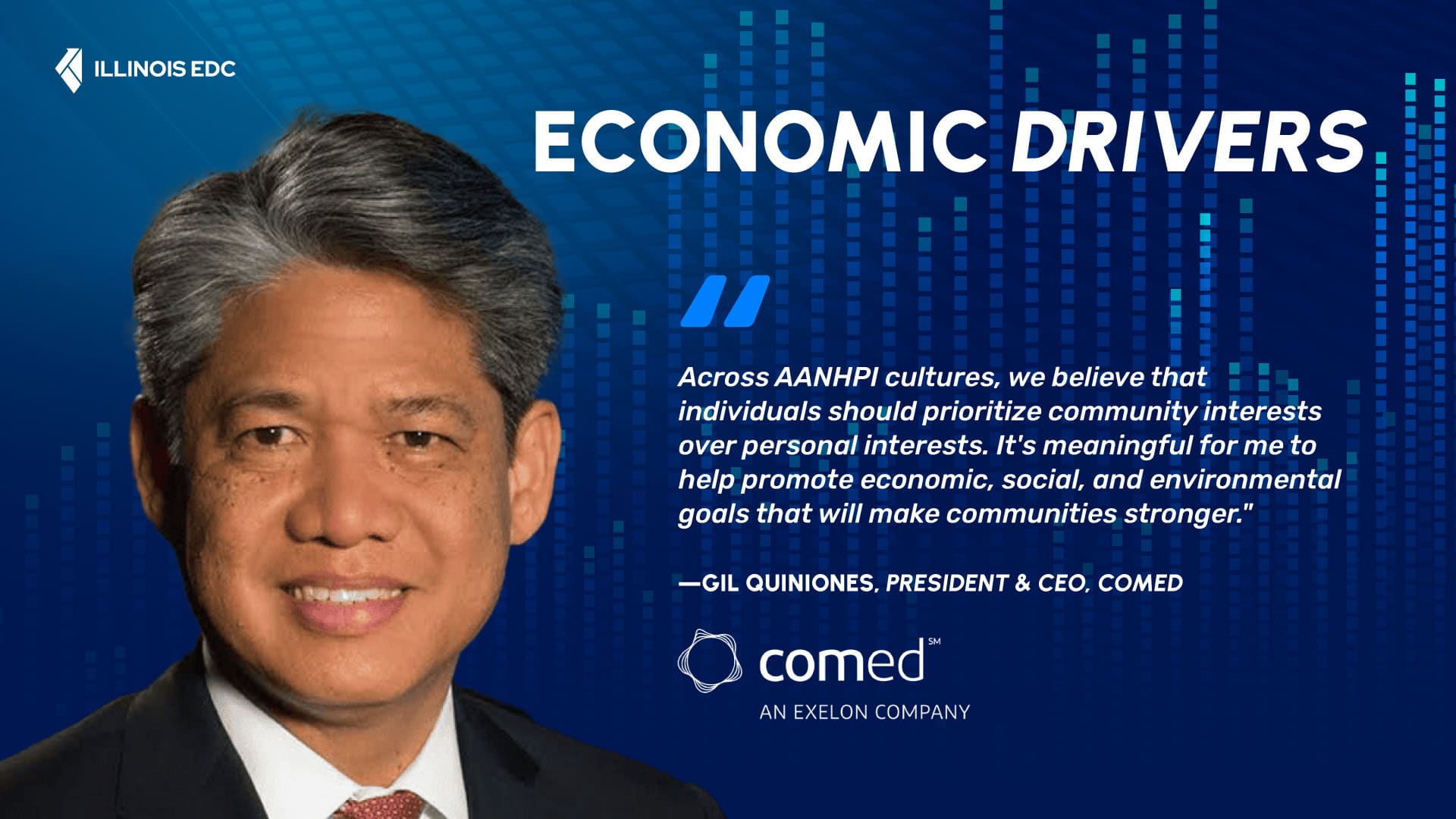
Illinois passed a nation-leading climate law on September 15, 2021–just two months before I would start as ComEd president and CEO. I greatly admired the ambition of the Climate and Equitable Jobs Act, which put forth a vision for a clean energy future where every community had an opportunity to help build it. And every community would have a stake in its success. Across AANHPI cultures, we believe that individuals should prioritize community interests over personal interests. It is extremely meaningful for me to be helping carry out a policy that promotes economic, social, and environmental goals that will make communities stronger.
What do you love most about living and working in Illinois?
I love the state’s rich history and the cultural vibrancy it has today, how each region finds creative ways to express its individual identity. Most of all, I admire the pride, the passion and the grit that Illinoisans bring to every endeavor.
What makes Illinois a strong place for AANHPI business leaders?
The diversity of the communities, certainly. But it’s far more than that, because this state shows you every day the value of diversity. It’s expressed in the cuisine, in the visual and performance arts. We see how every culture that comes to Illinois brings a fresh perspective and a unique historical experience. Against this backdrop, it’s clear to see both the cultural value and the business value of diverse leadership, including AANHPI individuals.
What polices, programs or networks in Illinois have supported your professional growth or your organization’s mission?
A few years ago, I was named a Daniel Burnham Fellow by the Leadership of Greater Chicago. Through that program I have built relationships with many of the city’s civic and business leaders. I learned more about the city’s history and the direction of its future. It helped me see the civic fabric of Chicago. In addition, I serve on the Executive Committee for the Chicago Community Trust, the board of the Illinois Economic Development Corporation and the board of World Business Chicago. This combination of programs and civic engagements gives me a well-rounded perspective on the challenges we face as a region but also the opportunities we have as leaders to advance progress and forge common cause.
How do you or your organization support your local community or underrepresented groups?
I serve on the board of the Greater Chicago Food Depository, a community-based organization that connects individuals with healthy nourishment but also strives to address the root causes of hunger and poverty. In addition, I am the co-chair of the Leadership Council for Corporate Coalition of Chicago, which is dedicated to building a corporate culture where companies prioritize racial and economic equity, not just as a moral or social imperative but because they recognize it has value to their business and to the region’s economy as a whole. The biggest source of pride, however, is as for what ComEd does an organization: Every year, we hold roughly 500 sponsored volunteer events and raise over a million dollars to support a wide range of nonprofit organizations, including one that is featured as our Cause of the Year. In the past, that cause has been food insecurity, Alzheimer’s research, suicide prevention, cancer prevention and—in 2026—homelessness. ComEd’s Asian American Resource Group is part of that volunteer network, and I’m proud to serve as its executive sponsor.
Are there any initiatives or organizations in Illinois that you’re proud to support?
Every year since arriving at ComEd, I have been the first one into the water for “Polar Plunge”—a chilly dip into Lake Michigan in early March to raise money for Special Olympics Illinois. We call it “Freezin’ for a reason,” and this year our fundraising total surpassed $400,000. Also, I have a friend who suffers from ALS, so I make annual donations to organizations that support research for a cure.
What inspires you to continue to affect change in your world?
I sometimes feel inspired by a conversation with another executive who belongs to Corporate Coalition, or when I am serving food to the hungry alongside other volunteers for Greater Chicago Food Depository. During the workday, I often feel inspired by the stories of heroism I hear about ComEd workers who go way above and beyond to help customers or people they may encounter when they’re in the community.
How can Illinois EDC help elevate or amplify your work and that of your organization?
Economic development is a major dimension work we do at ComEd, because we recognize that access to safe, reliable, affordable energy is a significant consideration for a wide range of businesses looking to locate here or expand their existing operations. Through Illinois EDC, however, I gain visibility into the region’s broader economic development strategy, so I can more clearly see the best ways ComEd can support. In addition, I get an opportunity to demonstrate the value of our services and how that can be leveraged as a competitive edge for our region.
What does AANHPI Heritage Month mean to you personally?
It’s a time to reflect on my cultural heritage and how my family and community have shaped my perspective and life experiences. I feel a deep sense of gratitude for my upbringing in the Philippines, my parents and the traditions of Filipino culture.
What would you say to a young AANHPI professional considering launching or relocating their career to Illinois?
The first thing I usually tell them is, “Yes, you really can find great Asian food in Chicago!” From dim sum and teahouses in Chinatown on the South Side to barbeques, cafes and markets of Koreatown in Albany Park and the northern suburbs, not to mention my personal favorite, Kasama, the first Filipino restaurant to be awarded a Michelin star. Beyond the cuisine, this state is teeming with opportunities for professional and personal growth, across a wide variety of industries. It’s also more affordable than many of the big cities in the Northeast and on the West Coast. If you want a slower pace of life and the idyllic charm of small towns, you can find that in western, central, and southern Illinois. For those who like a vibrant, walkable city with plenty of mass transit options—similar to those in metropolitan Asian countries—you can find all of that in Greater Chicago. Yes, winters can sometimes feel long, but the people of Illinois could not be warmer or more welcoming.
Favorite Illinois historical figure?
Abraham Lincoln for his honesty, integrity and moral compass. Ida B. Wells for her persistence, resourcefulness and courage. Michael Jordan for his fierce competitiveness and willingness to take the big shot. And even though Illinois Senator Tammy Duckworth is not a historical figure, I have to mention her as the first Thai-born woman elected to Congress.
Favorite book of all time?
The 7 Habits of Highly Effective People by Stephen R. Covey
Best business advice you’ve ever given (or received)?
Seek to understand before seeking to be understood.
RELATED POSTS