It’s an honor to elevate our next few Economic Drivers in celebration of Pride Month, starting with lifelong Illinoisan Joey Mak, CEO of Chicago:Blend!
What inspired your career path and industry involvement?
I’ve always been drawn to the connective tissue of communities—the people and relationships that make systems work. Chicago’s startup and VC ecosystem is full of brilliant builders who often don’t know each other. Chicago:Blend was born from a simple belief: when you bring the right people into the same room, remarkable things happen. My identity as an LGBTQ+ person also shaped that instinct—I know firsthand what it means to see (or not see) yourself reflected in a room.
As an LGBTQ+ leader in your field, what challenges have you faced, and how have you overcome them?
Venture and startup culture has historically been homogeneous in ways that go beyond gender or race—LGBTQ+ professionals are often invisible in these spaces, especially at the leadership level. I’ve navigated rooms where I had to make quick calculations about how much of myself to bring. What helped me most was building my own community and choosing to lead with full authenticity. Running Chicago:Blend has given me the platform to build the inclusive ecosystem I wish I’d found earlier.
Can you share a key moment in your career that shaped who you are today?
It’s hard to pick just one moment—my early career in state government was quietly formative in ways I didn’t fully appreciate until later. Working inside public-sector systems gave me an unusually grounded view of how policy, community, and economy actually intersect—and just as importantly, how they can fail people. That experience planted the seeds for my interest in economic and community development. My time at the University of Illinois deepened that further, giving me a sandbox to explore the overlap between tech, talent, and business in a way that felt both intellectually rigorous and practically relevant. Those two chapters together gave me the lens I bring to Chicago:Blend—an understanding that ecosystems are built by systems, and systems can be redesigned.
Who are (or have been) some of your mentors, role models, or inspirations?
Too many to name. I’ve had several mentors and role models over the years, including former bosses and managers that took the time to invest in and challenge me. Two of my current board members (Lindsay Knight of Chicago Ventures and Gale Wilkinson of VITALIZE Venture Capital) have been especially supportive of me in my current role. Broadly speaking, I’ve been inspired by community builders—people who saw gaps and filled them without waiting for permission. I’m also consistently inspired by the founders and fund managers I work with through Chicago:Blend who are quietly changing the face of the industry.
What does success look like to you—professionally and/or personally?
Professionally, success looks like a Chicago ecosystem where an LGBTQ+ founder or investor never feels like an anomaly—where our community is woven into the fabric of the city’s economic story. Personally, it looks like a life lived with integrity and genuine connection.
How does being in Illinois contribute to your success as an LGBTQ+ leader (if it does)?
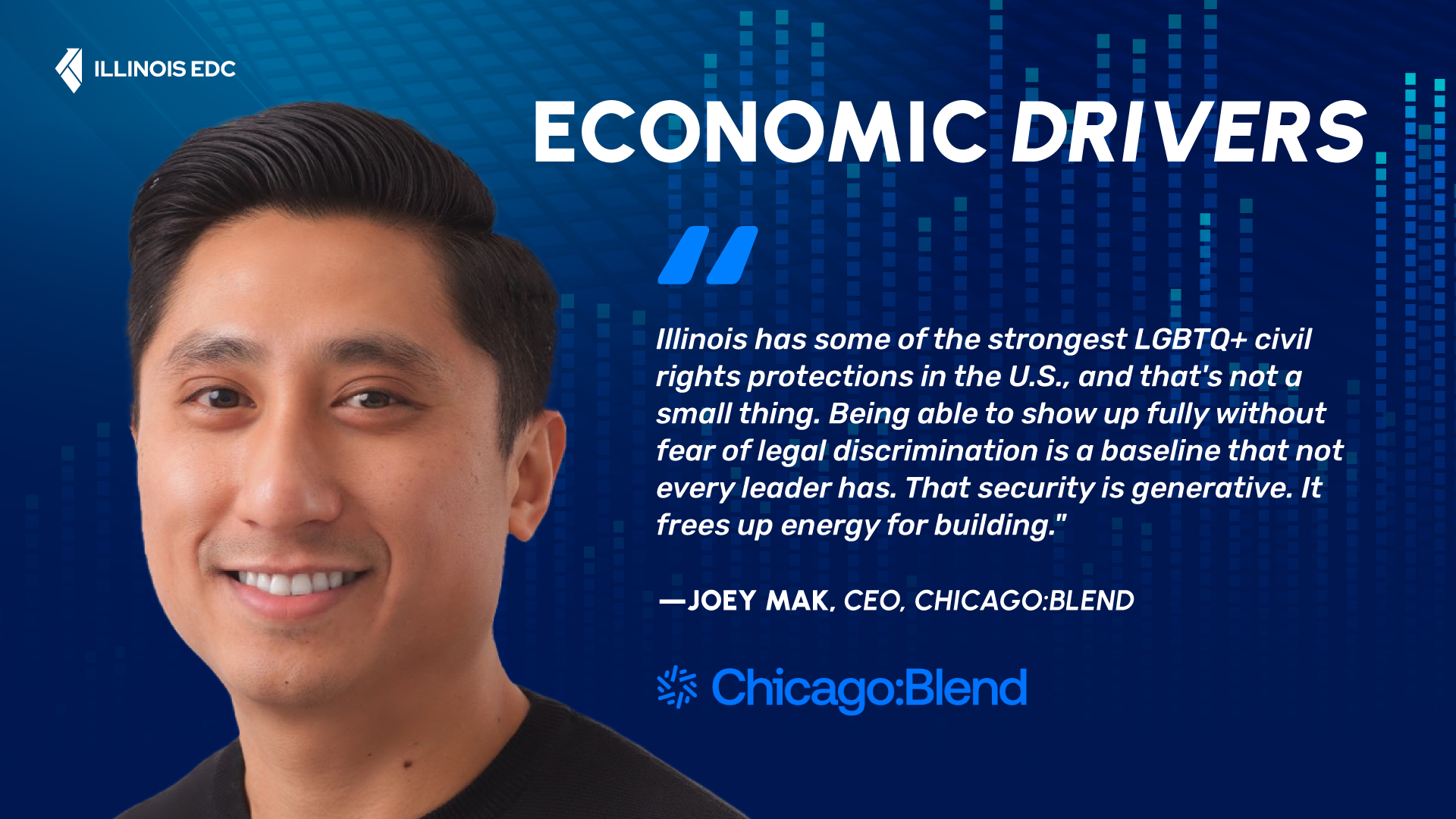
Chicago is a city that rewards hustle and authenticity in equal measure. Unlike some coastal ecosystems, there’s a collaborative energy here—people genuinely want each other to succeed. That ethos made it possible to build Chicago:Blend. But foundation matters too: Illinois has some of the strongest LGBTQ+ civil rights protections in the country, and that’s not a small thing. Being able to show up fully—in a boardroom, at a pitch meeting, in a sponsorship conversation—without fear of legal discrimination is a baseline that not every LGBTQ+ leader across the country has. That security is generative. It frees up energy for building.
What do you love most about living and working in Illinois?
The people. Illinois has an unpretentious, show-don’t-tell culture that I find refreshing. There’s also a genuine diversity of communities, of industries, and of lived experiences that makes the Illinois endlessly interesting.
What makes Illinois a strong place for LGBTQ+ business leaders?
It starts with the legal foundation. Illinois has long been ahead of the curve on LGBTQ+ civil rights protections, and that matters more than people often acknowledge. Safety and legal equity aren’t just moral imperatives; they’re economic ones. Leaders do their best work when they’re not spending energy managing risk around their identity. But beyond policy, Chicago and Illinois have a culture of LGBTQ+ civic and economic leadership that runs deep. That history creates a different kind of confidence and belonging. The business community here has also become increasingly intentional about inclusion in a way that feels substantive rather than performative. What excites me most is the momentum. There’s a growing critical mass of LGBTQ+ founders, investors, and operators in Illinois, and the infrastructure to connect them is finally catching up.
What policies, programs, or networks in Illinois have supported your professional growth or your organization’s mission?
Illinois punches above its weight when it comes to the infrastructure that drives innovation—and that infrastructure has been meaningful to my growth. The sheer density of world-class higher education institutions in and around Chicago creates a constant pipeline of forward-thinking ideas, research, and talent that keeps the ecosystem intellectually alive in a way that’s hard to replicate elsewhere. On the network side, organizations like World Business Chicago and the Chicagoland Chamber of Commerce have been intentional about creating space for LGBTQ+ leaders in economic development conversations—not as a side program, but as part of the main event. The incubator and accelerator community here—1871, mHUB, TechNexus, and others—has also been genuinely proactive about inclusive programming and events, which signals to emerging LGBTQ+ founders that they belong in these spaces. I’d also highlight StartOut, whose Chicago chapter has been a vital connector for LGBTQ+ entrepreneurs and professionals nationally and locally. Having a network that specifically names and celebrates LGBTQ+ business leadership matters—it creates community where there might otherwise be isolation.
How do you or your organization support your local community or underrepresented groups?
Chicago:Blend’s core mission is community-building across the VC and startup ecosystem with an intentional lens on inclusion. Through programming and events, we create space for underrepresented founders, funders, and operators to find each other—because proximity leads to partnership, and partnership leads to capital and opportunity. We also run a fellowship program designed to help overlooked talent break into venture capital. That work feels particularly important to me because diverse check-writers aren’t just a diversity metric—they’re a market correction. When more varied perspectives sit at the investment table, capital flows to ideas and founders that homogeneous networks have historically missed. That’s not just good for inclusion; it’s good for returns and for the broader economy.
Are there any initiatives or organizations in Illinois that you’re proud to support?
Chicago:Blend sits at the center of a rich network of organizations all working toward a more inclusive and dynamic business community, and I’m proud of the collaborations we’ve built. On the civic and economic development side, we partner with P33’s TechChicago Week and World Business Chicago’s ThinkChicago—two initiatives that put Chicago’s innovation ecosystem on the national map. The Chicagoland Chamber of Commerce has also been a meaningful partner in connecting our work to the broader business community. We collaborate closely with organizations focused on underrepresented communities in venture and entrepreneurship—BLCK VC, LaFamilia Foundation, and StartOut among them — because our missions are deeply complementary. And our incubator and accelerator partners—1871, mHUB, MATTER, 2112 Chicago, and TeamWorking by TechNexus—are where a lot of the day-to-day community-building actually happens. What I love about this ecosystem is that these organizations aren’t competing—they’re compounding. Every partnership makes the whole stronger, and Chicago:Blend’s strengths are built on working in tandem with them.
What inspires you to continue to affect change in your world?
Honestly, the people. Every time I see a connection made through Chicago:Blend that turns into a partnership, a funding round, or a friendship—that’s the fuel. I also think about the next generation of LGBTQ+ professionals entering these spaces and want them to walk into a better room than I did.
What does Pride Month mean to you personally?
Pride is both a celebration and a call to action—and I think it’s important to hold both of those things honestly. What we now know as Pride parades began as protests. Stonewall wasn’t a parade; it was an uprising. That origin matters, and I worry that as Pride has become more mainstream and more commercialized, we risk losing the thread. Visibility and celebration are meaningful—I don’t want to minimize that. But visibility without systemic change is incomplete. Pride Month should push us past the performative: the rainbow logos, the one-month spotlights, the gestures that don’t survive the first of July. The real work is in the policies, the capital allocation, the hiring decisions, and the legal protections that determine whether LGBTQ+ people can actually thrive—not just be seen. For me personally, Pride is a reminder of why organizations like Chicago:Blend exist year-round. Inclusion isn’t a single month. It’s infrastructure.
What would you say to a young LGBTQ+ professional considering launching or relocating their career to Illinois?
Come. Illinois is a state that will meet your ambition and your authenticity with open arms. The ecosystem here is growing fast, the cost of living makes risk-taking more viable than on the coasts, and there is a real and growing community of LGBTQ+ leaders who want to see you succeed. Find your people—and if you can’t find them, build the room yourself.
Favorite Illinois historical figure:
Gwendolyn Brooks, Carl Sandburg, and (obviously) Abraham Lincoln
Favorite book of all time:
A Short History of Nearly Everything by Bill Bryson
Best business advice you’ve ever given (or received):
Collect mentors—and be intentional about the range. You need people who are 20+ years ahead of you to help you see the long arc, and people who are just a few years ahead to help you navigate what’s immediately around the corner. Both perspectives are invaluable, and neither replaces the other. But the advice I find myself giving most often is the second half of that equation: give back. Mentorship isn’t a transaction you complete once you’ve “made it.” It’s a practice. The most impactful leaders I know are as intentional about who they’re pulling up as they are about who they’re learning from.
RELATED POSTS