Back to posts

Welcome to our latest installment of our Economic Drivers series profiling AANHPI business leaders for May’s Asian American, Native Hawaiian, and Pacific Islander Heritage Month! We’re deeply honored to spotlight Founder & CEO of SPAAN Tech Inc. and Illinois EDC Board Member Smita Shah, who is a proud lifelong Illinoisan. As you’ll quickly learn, her story is one worth your attention.
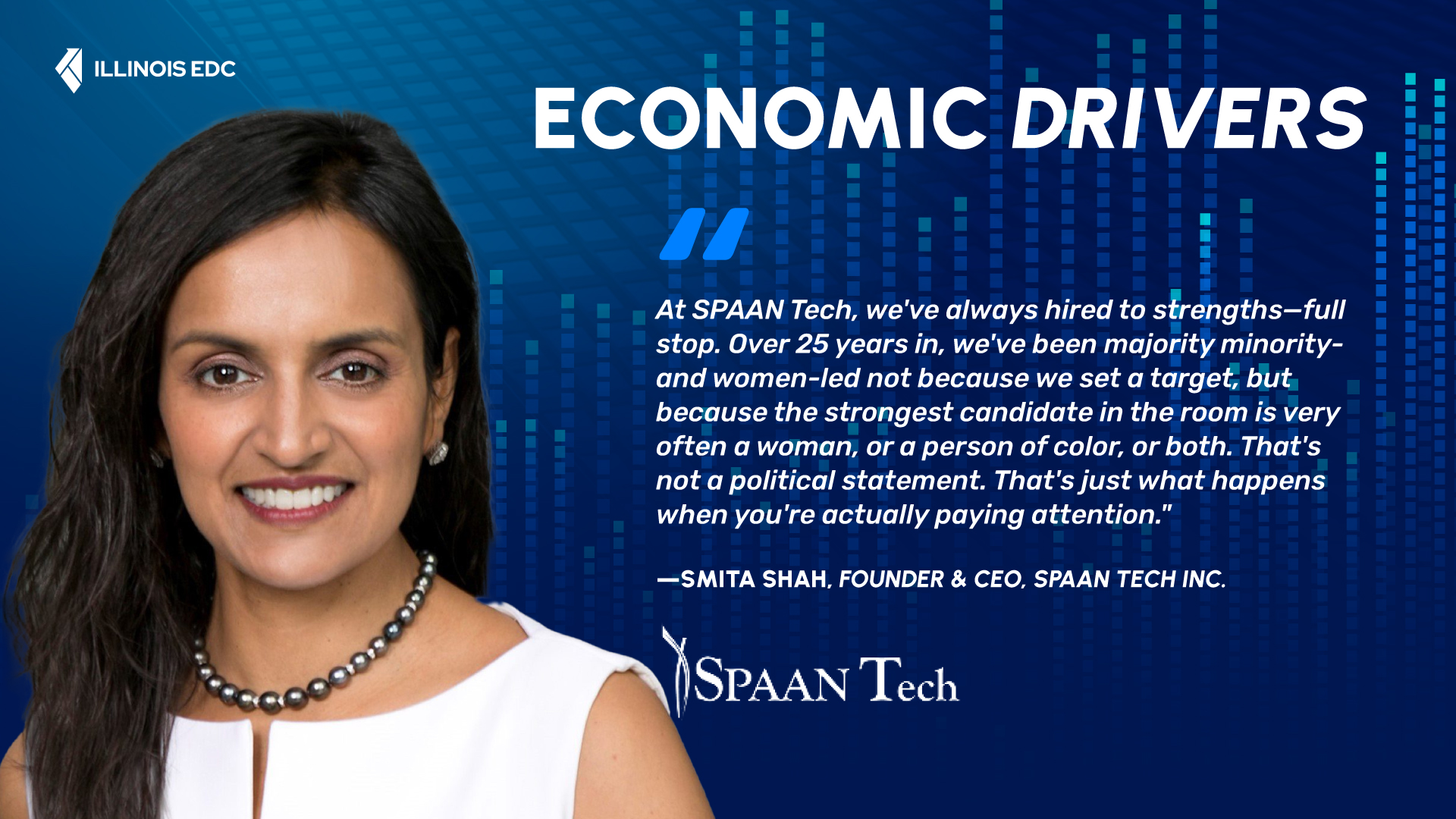
Meet Economic Driver: Smita Shah, Founder & CEO, SPAAN Tech Inc.

How long have you lived and worked in Illinois?
My whole life. Born in Chicago, grew up in Willowbrook, went away for school, and came back. This is a city that reversed the flow of a river. Engineers here don’t think small. I wanted to be part of that. I started SPAAN Tech here in 1998 and I’ve never had a moment where I thought I should have done it somewhere else.
What inspired your career path and industry involvement?

I’ll be honest: I was kind of a dorky kid. In fifth grade in Willowbrook, I was the one in the back of the classroom turning word problems into algebra equations because it was fun. In high school at the University of Chicago Lab School, I ran math relays—which, yes, are exactly what they sound like—and I kept every ribbon. So when it came time to figure out what to do, my father, a civil engineer himself, said simply: If you’re good at math and science, you become an engineer. I thought, okay. That’s apparently how it happens. What surprised me was how much I loved it. There was a moment at MIT, in a structural dynamics lecture, where a professor explained why a bridge shudders under your feet when a truck crosses it. Something just clicked. I remember thinking—this is what I want to do. I’ve never questioned it since. I started SPAAN Tech in 1998 because I saw a gap that felt made for a trained engineer: Technology was transforming every sector of the economy, but someone still needed to understand the physical infrastructure underneath all of it—the wires behind the walls, the electrical systems, the facilities that made it possible for technology to actually function. Everyone was racing toward the digital future. I was interested in what held it up. That turned out to be a useful thing to be interested in.

As an AANHPI leader in your field, what challenges have you faced, and how have you overcome them?
The construction and engineering industries are not places that have historically made it easy to be an Asian Indian woman. I knew that going in, and I made a decision early on that I wasn’t going to spend a lot of energy being surprised by it. The assumptions came in all shapes. Calls addressed to “Mr.” Shah. Walking into rooms where people were clearly looking past me for whoever was actually in charge. The occasional, genuinely baffling compliment about how well I spoke English—extended to a woman who was born and raised in Chicago. None of it was subtle, and none of it was meant to be. The message was always some version of: We didn’t expect you. My answer to that, every time, was the same. Do the work. Do it better than anyone thought you would. And do it especially when the conditions are hard. Early in my career, the Illinois Tollway offered me my first prime contract—a parking lot resurfacing job that three other firms had already turned down because the lot sat directly outside the Tollway’s main offices, meaning every person with a desk and a window felt entitled to supervise the project in real time. Nobody wanted that kind of scrutiny. I took it precisely because I understood scrutiny. We executed it without flinching, and when it was done, the Tollway knew our name. Every contract that came after traces some line back to that parking lot. You overcome by being undeniable. That’s the only method I’ve ever found that actually works.
Can you share a key moment in your career that shaped who you are today?
One of our early projects was a streetlight installation in a neighborhood that had been struggling with safety at night. Not a headline project by any measure. But when it was done, residents came up to us personally to say ‘thank you.’ They could go outside again after dark. That was it—a streetlight—and it changed the texture of daily life for real people. I think about that project a lot. It’s easy to get caught up in the scale of things—the airport runways, the larger infrastructure work—and lose sight of why any of it matters. That streetlight reminded me: Infrastructure is personal. It’s not about the engineering. It’s about what becomes possible for somebody once the engineering is done. That’s stayed with me as the real measure of the work.
Who are (or have been) some of your mentors, role models, or inspirations?
Maggie Daley shaped a lot of how I think about civic life. She built After School Matters from the ground up and gave thousands of Chicago kids somewhere purposeful to be after the bell rang. She also, early in my career, quietly opened doors for me—not in a big dramatic way, just by including me, by treating me as someone worth knowing. I’ve never forgotten what that felt like, and I try to do it for other people whenever I can. My father is the other constant. He came to America as the son of a man born in a village in India without running water, became a civil engineer, and raised his daughter to believe that giving back wasn’t optional—he taught me that it was the whole point of having been given anything. That’s shaped everything. And then there’s Swami Vivekananda. In 1893, a 30-year-old Indian monk arrived in Chicago almost by accident, without the proper credentials to attend the Parliament of World Religions. He nearly didn’t get in. When he finally took the stage at what is now the Art Institute of Chicago, before 5,000 people representing every major religion on earth, he did something no one had done before: He told them they were all right. That no faith holds a monopoly on truth. That every tradition, in its own way, points toward the same light. He opened with “Sisters and brothers of America”—and the room erupted before he’d said another word. He closed with “Help and not fight. Assimilation and not destruction. Harmony and peace and not dissension.” In 1893. In Chicago. The world was not accustomed to hearing that. In an era when empires were built on the premise that some peoples and some beliefs were simply superior to others, here was a young man from India standing in our city saying: no. Everyone belongs. Everyone has something true to offer. The crowd gave him a two-minute standing ovation before he’d spoken a single sentence of his prepared remarks. What moves me is how much more urgent that message sounds now than it did then. We live in a moment of profound fracture—between faiths, between communities, between people who have decided the other side is simply wrong and not worth understanding. Vivekananda didn’t ask anyone to abandon what they believed. He asked everyone to be curious about what someone else believed. That feels like a radical act in 2026. And it happened first on our lakefront. That matters to me.
What does success look like to you — professionally and/or personally?
Success, for me, shows up in the work and in the people doing it. At SPAAN Tech, we’ve always hired to strengths—full stop. What does this project need? Who is the best person for it? When that’s genuinely the question you’re asking, something interesting happens: You end up with a team that looks like the world. Over 25 years in, we’ve been majority minority- and women-led not because we set a target, but because the strongest candidate in the room is very often a woman, or a person of color, or both. That’s not a political statement. That’s just what happens when you’re actually paying attention. I’d love to see more firms find that out for themselves.
How does being in Illinois contribute to your success as an AANHPI leader (if it does)?
Illinois, for as long as I can remember, has made a point of seeking out AANHPI voices—not just tolerating them, but genuinely looking for them. Commissions, advisory councils, civic initiatives: There was consistent, institutional effort to make sure different communities were actually in the room. As a young professional, that meant I got access to conversations and relationships I hadn’t yet earned in the traditional sense. The door was open. I walked through it, and I tried to make the most of the fact that someone left it open. Over time I’ve watched the AANHPI community move from being invited to leading. That shift doesn’t happen without the underlying infrastructure of a state that actually cares about it.
What do you love most about living and working in Illinois?
Illinois is the center of the country in more ways than just geography. I spent seven years on the Illinois Arts Council, chairing the Master Apprentice Program, and at one point we had a reviewer visiting from out of state who looked at the range of what we were doing—traditional artists from India, from Peru, from communities all across the world, being paired with apprentices and passing down living traditions—and he just shook his head. “You don’t realize how lucky you are,” he said. He was right. The food, the architecture, the cultural richness—all of it is a direct expression of the people who have chosen to build their lives here. I find that endlessly interesting. I never want to stop being curious about my own city.
What makes Illinois a strong place for AANHPI business leaders?
There are states with good intentions and not much infrastructure to back them up. And there are states with infrastructure and not much genuine commitment to who gets to use it. Illinois, at its best, has both. The workforce is genuinely diverse. The capital access, the business development organizations, the technical assistance networks—they exist at a scale that actually helps smaller firms compete. And the political and civic leadership here has, more often than not, understood that a community is only as strong as its least-supported members. That’s not just a nice thing to say. It shows up in how institutions are built and who gets invited to help build them.
What policies, programs, or networks in Illinois have supported your professional growth or your organization’s mission?
ACEC Illinois has been a constant—a place to stay current, to build real relationships across the industry, to be part of a professional community that takes the work seriously. Illinois EDC has been genuinely committed to making sure diverse voices aren’t just consulted at the margins but are part of how economic strategy gets made. Chicago Sister Cities International, and particularly the Delhi Committee that I have the privilege of chairing, has connected me to people and possibilities I couldn’t have reached alone—including leading trade missions to India with the Mayor. And honestly, MIT deserves a mention. The MIT community showed me that an engineer doesn’t have to stay in one lane—that you can sit on an arts council, serve on a political committee, work in civic spaces that have nothing to do with infrastructure. That turned out to be one of the most useful things I ever learned.
How do you or your organization support your local community or underrepresented groups?
We made a decision early on that SPAAN Tech would be a place where civic life wasn’t something you did quietly on your own after hours—it was part of the culture we built together. One of our engineers spends his spare time helping restore Frank Lloyd Wright buildings. Another serves on a local school board. Someone else leads advocacy around gun violence prevention. The range of what people on our team choose to show up for is genuinely moving to me. I think a company reflects what it actually values, not just what it says it values. What I hope ours reflects is that the work of an engineer doesn’t end at the project boundary. Infrastructure exists inside communities. And communities need more than well-designed roads.
Are there any initiatives or organizations in Illinois that you’re proud to support?
Education is where I keep coming back. I serve on the boards of the Museum of Science and Industry, Navy Pier, After School Matters, the Lincoln Academy of Illinois, and Chicago Sister Cities International. What these organizations share is a belief that expanding what a young person thinks is possible for them—showing them science, or art, or the world beyond their neighborhood—is one of the highest-leverage things you can do. The change that comes from that kind of exposure is generational. It’s slow, and you don’t get to see most of it. But it’s real, and it compounds. I’m glad to be part of it in whatever way I can.
What inspires you to continue to affect change in your world?
My MIT professor used to say: We’re engineers—making change is not something we do on the side, it’s the whole job. I’ve always believed that. But what keeps me personally motivated, after all these years, is something quieter than a mission statement. Every project we touch is going to outlast me. That’s just the nature of infrastructure—it’s built to last, built for people who aren’t here yet. And if the work is going to outlast me, it had better make things genuinely better for the people who come after. I find that thought less daunting than clarifying. It’s not about legacy. It’s about getting the design right.
How can Illinois EDC help elevate or amplify your work and that of your organization?
Illinois EDC’s mission is to make Illinois the premier place to live, work, and do business—and to make sure that economic opportunity reaches every community across the state, not just the loudest ones in the room. That last part is where I think SPAAN Tech has something real to contribute. Small businesses employ close to half the American workforce. They are not a footnote to the Illinois economy—they are the Illinois economy. And AANHPI-owned firms specifically bring something that doesn’t show up in a site selection report: networks, trade relationships, and deep cultural fluency that connect Illinois to some of the fastest-growing economies in the world. Illinois EDC can amplify that by making sure businesses like ours aren’t just data points in a diversity initiative, but genuine partners in telling the story of what Illinois is becoming. That’s a story worth telling loudly. We’d be glad to help tell it.
What does AANHPI Heritage Month mean to you personally?
Something I think is worth saying clearly: AANHPI is not a single identity. It is one of the most internally diverse groupings in American public life—dozens of cultures, languages, histories, traditions, generations of immigration, all gathered under one umbrella. What Heritage Month means to me is the recognition that this diversity within diversity is something to be celebrated, not flattened. That communities as genuinely different as ours can choose to find common ground, and that when they do, they build something more durable than any one of them could build alone. On a simpler level, it just feels like coming home. There’s no agenda. There’s food. There are people I’ve known for 30 years and people I’m meeting for the first time. That ease is rarer and more valuable than it looks.
What would you say to a young AANHPI professional considering launching or relocating their career to Illinois?
Come. I grew up as a first-generation Chicagoan in a suburb where my family was very much the exception, and I know what it’s like to find your footing in a place that wasn’t originally designed with you in mind. What’s different now is that Illinois has been actively building the conditions for AANHPI professionals to succeed—the community organizations, the civic infrastructure, the institutions that take inclusion seriously as a practice rather than a performance. Add a world-class city with a cost of living that actually allows you to build something, and a state that is genuinely on an upswing, and you have something worth paying attention to. The opportunity here is real. It’s why I came back every time I had the chance to stay somewhere else.
Anything else you’d like to share?
When I started SPAAN Tech in 1998, the world was at an inflection point. Technology was changing everything and nobody was quite sure what came next. What I understood then was that someone needed to see around the corner—to ask not just where the technology was going but what it was going to need underneath it. That instinct built this company. We’re at another one of those moments now. The economy is shifting, priorities are being reshuffled, and the path forward is genuinely uncertain. That’s exactly when you need engineers at the table. Not just to build things, but to think through what needs to be built, what will last, and what a community actually needs to thrive. That’s what SPAAN Tech has always done. And it’s why I think the most important thing Illinois EDC can do right now is make sure that firms with that kind of long view—firms that have been reading this state and its needs for decades—are part of the conversation about what comes next.
Favorite Illinois historical figure:
Jane Addams. She moved into one of Chicago’s poorest neighborhoods in 1889 and stayed. For 40 years. She fought for clean water, safe streets, kids out of factories and into schools—all of it from a house on Halsted Street. She won the Nobel Peace Prize and I’m not sure she ever stopped to notice. For an engineer, she’s a reminder that the point of building things is the people who have to live with them.
Favorite book of all time:
The Count of Monte Cristo by Alexandre Dumas. It’s just a great book—long, rich, completely absorbing. But the thing that stays with me is the patience. This man loses everything, and instead of reacting, he waits. He plans. He plays the long game for years before anyone even knows he’s playing. I find that compelling. Good things—real things—take time. I’ve always believed that. Dumas just makes it a much better story than I could.
Best business advice you’ve ever given (or received):
Do the work other people think is beneath them. That’s where the opportunity always is.